
California ADA shower compliance means meeting exact, measurable requirements that determine whether a shower can be used independently by a person with a disability. In California, those requirements are enforced under both the 2010 ADA Standards and California Building Code Title 24 Chapter 11B. Inspectors measure finished conditions in the field, not product labels, drawings, or intent.
Here’s the reality most owners learn too late. Showers fail inspection because a grab bar is two inches short, controls are placed for standing users, or a roll in shower was installed where a transfer shower was required. These are not judgment calls. They are pass or fail measurements taken with a tape measure during inspection.
This article breaks down how California actually enforces ADA shower rules. You’ll see when roll in showers are mandatory, when transfer showers are allowed, where grab bars must be placed, how seats and controls are measured, and the most common failure patterns that delay openings or trigger corrections. If the shower does not work exactly as required, it does not pass.
What Makes a Shower ADA-Compliant in California
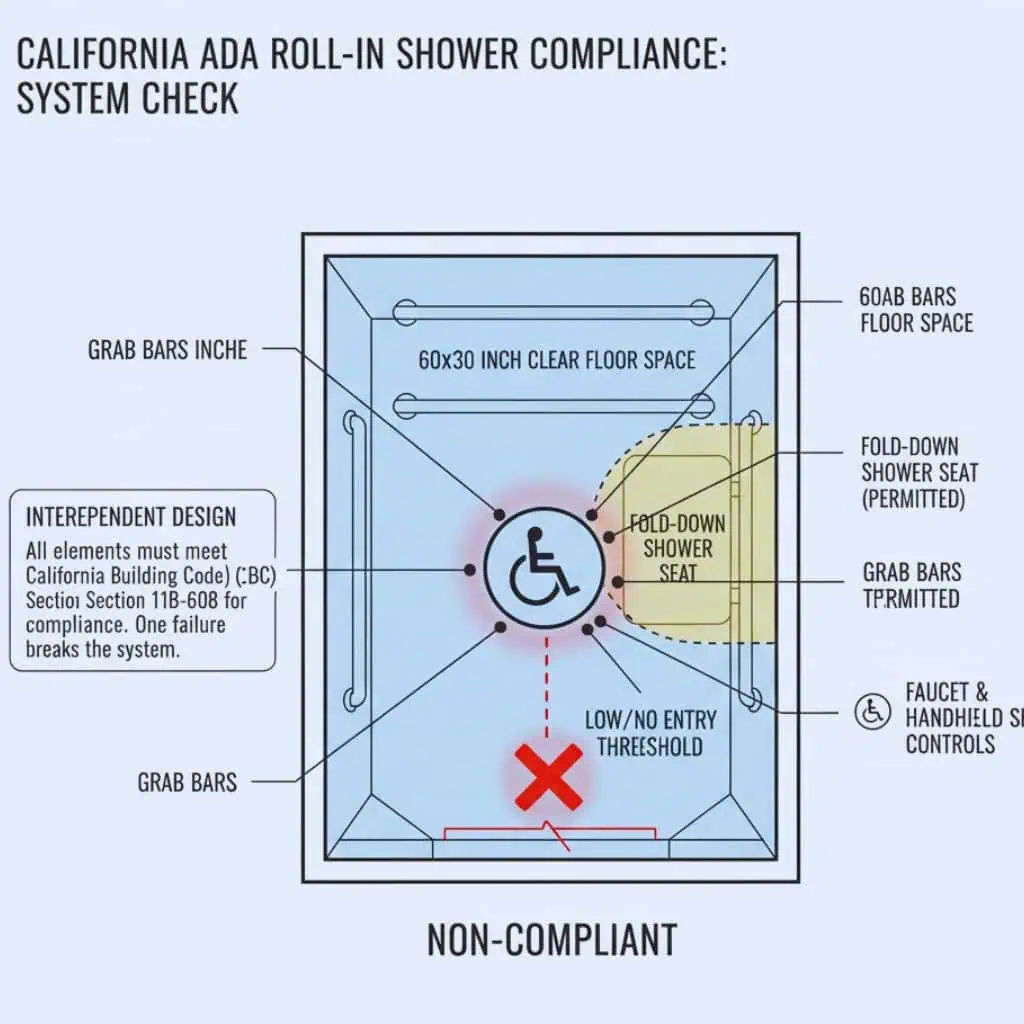
ADA-compliant showers in California are not defined by product labels or intent. Compliance means a guest with a disability can enter, use, and exit the shower independently, and that the installation passes field inspection under the ADA 2010 Standards and California Title 24. If either fails, the shower fails.
Here’s what that means in practice. Inspectors do not evaluate shower parts in isolation. They evaluate the shower as a working system. Size, seat location, grab bars, controls, clear floor space, and approach all have to function together. A shower can meet the minimum dimensions on paper and still fail if one element breaks usability.
California enforcement is stricter than federal ADA minimums because Title 24 is a building code, not guidance. Inspectors measure from finished surfaces, test reach from a seated position, and document real use conditions. There is no allowance for close enough or manufacturer diagrams.
A common failure pattern looks like this: a roll-in shower meets the size requirement, the grab bars are at the right height, but the controls are placed just beyond reach from the seat. On drawings, it passes. In the field, a seated user cannot operate the water without standing. Inspection fails.
That is how compliance is judged in California. Not by labels. Not by intent. By whether the shower works, end to end, for the person it is built for.
Which California Buildings Must Follow ADA Shower Requirements

This is the question that decides whether you are planning correctly or walking into a failed inspection later. ADA shower requirements do not apply everywhere, but when they do apply, they are enforceable and non-negotiable. The mistake most owners make is assuming the rule is based on whether a shower exists. It isn’t. The rule is based on how the building is classified and how the space is used.
Here’s what that means in practice. Two buildings can have identical showers and be treated completely differently under the law. Inspectors don’t look at fixtures first. They look at occupancy, access, and use, then apply the standards that follow.
Are ADA-Compliant Showers Required in All Commercial Buildings in California?
No. ADA-compliant showers are not required in every commercial building. They are required when a building is classified as a public accommodation or a commercial facility and the scope of work triggers accessibility obligations.
Public accommodations include places where the public is invited in to receive goods or services. That category covers hotels, gyms, spas, medical clinics, shelters, and similar facilities. When showers are provided in these spaces, accessibility is not optional. If the shower is part of the service offered, it must be usable by a person with a disability under ADA 2010 and California Title 24.
Commercial facilities are treated differently. Many office buildings, warehouses, and industrial facilities are not required to make showers accessible unless the shower serves a public-facing or shared employee function that triggers compliance. This is where projects get flagged. Owners assume employee-only means exempt, then add a fitness room or locker area that quietly crosses the line.
Inspectors do not guess intent. They evaluate how the space is actually used. If a shower is available to occupants or the public in a way that falls under ADA scope, the requirements apply.
Do Hotels, Apartments, Offices, and Medical Buildings Follow the Same Shower Rules?
No. The rules change based on occupancy type and use. This is one of the most misunderstood areas of ADA compliance.
Hotels are the clearest case. Guest room bathrooms fall under ADA scoping rules tied to room counts. Some accessible rooms must contain compliant showers, and some of those must specifically be roll-in showers. This is not a design preference. It is a scoping requirement, and inspectors verify it at the inventory level, not room by room.
Apartments and multifamily housing follow a different framework. Most dwelling units are governed by Fair Housing standards, not ADA. However, common-use spaces such as fitness rooms, pools, and locker rooms are subject to ADA requirements. This is where owners get surprised. The units may be exempt, but the shared shower is not.
Office buildings and medical facilities depend heavily on use. A private office shower used by a single employee is treated differently than a clinic shower used by patients. Medical buildings almost always trigger accessibility because showers are tied to patient care. Inspectors treat those showers as functional medical elements, not amenities.
If you take one rule from this section, it should be this: the same shower can be compliant in one building and a violation in another, depending entirely on classification and use.
Roll-In vs Transfer Showers Under California ADA Rules

This distinction matters because it is one of the fastest ways a project fails inspection. Roll-in and transfer showers are not interchangeable. They serve different users, require different layouts, and are required in different situations under ADA scoping rules.
Designers often treat this as a layout decision. Inspectors treat it as a compliance requirement.
What Is the Difference Between a Roll-In Shower and a Transfer Shower?
A roll-in shower is designed for users who remain in a wheelchair while entering and using the shower. It requires a curb-free entry, specific minimum dimensions, and control placement that can be reached from a seated position. These showers demand more floor space and tighter coordination. When done incorrectly, they fail quickly and visibly.
A transfer shower is designed for users who transfer from a wheelchair onto a fixed shower seat. These showers are smaller, have a curb, and rely heavily on correct seat placement and grab bar configuration. When the seat or controls are even slightly off, inspectors flag them immediately.
Here’s the practical difference. A roll-in shower fails when space, slope, or reach is wrong. A transfer shower fails when seat location, grab bars, or control distance are wrong. Both failures are common. Neither is negotiable.
Which Shower Type Is Required and When?
You do not get to choose the shower type freely. ADA scoping rules determine when roll-in showers are required, particularly in hotel guest rooms and certain public accommodations. A minimum number of accessible rooms must provide roll-in showers. The rest may use transfer showers, but only if all technical requirements are met.
This is where projects go wrong. Teams install transfer showers everywhere because they are easier to fit. On paper, the room looks accessible. At inspection, the inventory fails because the required roll-in count is missing.
Inspectors do not approve intent. They approve compliance. If the required shower type is not present in the required quantity, the building does not pass, regardless of how well the rest of the work was done.
Why This Matters
Most ADA shower failures are not caused by missing features. They are caused by misunderstanding applicability and scoping. Owners assume the rules don’t apply. Designers assume one shower type fits all. Contractors assume product labels equal compliance.
Inspection reality is simpler and harsher. If the building type triggers ADA, and the shower type is wrong for that use, the space fails. Fixing it later costs more and delays everything.

Exact Dimensional Requirements for ADA-Compliant Showers in California

This is where projects pass or fail. Not because the shower is missing, but because the dimensions do not work for real use. Inspectors do not rely on product labels, drawings, or intent. They measure finished conditions. If the numbers are off, the shower fails. California enforces these dimensions strictly under the 2010 ADA Standards and Title 24. There is no rounding, no tolerance, and no credit for being close.
Here is exactly what inspectors measure in the field.
Minimum Size and Clear Floor Space for Roll In Showers
A roll in shower is a curb less shower designed for a wheelchair user to enter and use without transferring. Because the user stays in the chair, space and approach matter more than anything else.
For a roll in shower to pass inspection, inspectors verify the following conditions together, not in isolation.
The minimum interior shower size must be 60 inches by 30 inches. That measurement is taken inside the finished walls, not from framing or drawings. Tile thickness and wall finishes count.
The shower must be curb less. Any lip, threshold, or change in level that interrupts wheelchair entry is a failure under ADA and Title 24. Inspectors check this visually and with a level.
The clear floor space at the shower opening must allow a wheelchair to approach and enter. This space must remain clear after doors, curtains, or hardware are installed. A shower that meets size requirements but is blocked by a swinging door or fixed panel still fails.
Here is the inspection reality. Many roll in showers fail because the space works on paper but not once glass, doors, or accessories are added. Inspectors measure what exists, not what was intended.
If a wheelchair user cannot enter the shower independently, the shower is not accessible, regardless of size.
Transfer Shower Size, Entry, and Alignment Rules
A transfer shower is designed for a user to move from a wheelchair onto a fixed shower seat. Because the user transfers, alignment and interior dimensions are critical.
The interior shower size must be 36 inches by 36 inches. This is a hard minimum. Anything smaller fails immediately. Inspectors measure wall to wall at finished surfaces.
The shower opening must be aligned to allow a side transfer from the wheelchair to the seat. This is not a visual judgment. Inspectors evaluate whether a wheelchair can position next to the opening without obstruction.
The clear floor space outside the shower must support a side transfer. If the toilet, vanity, or door swing blocks that space, the shower fails even if the interior size is correct.
This is where most transfer showers fail. The shower itself is built correctly, but the surrounding layout makes transfer unsafe or impossible. Inspectors treat the shower and adjacent floor space as one system.
A transfer shower that cannot be transferred into is not accessible. Inspectors do not allow partial compliance.
ADA Shower Grab Bar Requirements That Inspectors Enforce

Grab bars are one of the fastest ways an otherwise compliant shower fails inspection. Not because they were omitted, but because they were installed as accessories instead of load bearing supports. Inspectors do not look at grab bars in isolation. They evaluate whether the bars are positioned to support entry, transfer, and seated use without improvisation by the guest.
Here’s how those requirements are enforced in California.
Required Grab Bar Locations by Shower Type
Grab bar placement depends entirely on the shower type. Inspectors do not accept hybrid layouts or partial installations. Each configuration has specific wall requirements, and missing one bar is enough to fail the room.
In roll-in showers, grab bars are required on the back wall and the side wall opposite the seat. These bars support entry, repositioning, and stability while seated. Installing bars only on one wall or centering them for visual symmetry is a common failure.
In transfer showers, grab bars are required on the back wall and the control wall. This layout supports the side transfer from wheelchair to seat and allows the user to stabilize before operating controls. Inspectors frequently fail transfer showers where the control wall bar is omitted to accommodate valve trim or tile patterns.
In tub showers, grab bars are required at the back wall and both end walls, positioned to support entry and exit along the full length of the tub. Decorative end wall bars or shortened bars near fixtures do not meet this requirement.
Inspectors verify wall by wall. If a required wall lacks a bar, the shower fails regardless of how solid the other bars are.
Grab Bar Height, Length, and Mounting Rules
Grab bars must be mounted 33 to 36 inches above the finished floor, measured to the top of the gripping surface. Inspectors measure from finished tile, not rough framing or assumed heights. Being outside this range by even an inch is a documented violation.
Length matters just as much as height. Required grab bars must meet minimum lengths to allow repositioning and continuous support. Shortened bars, interrupted bars, or bars trimmed to avoid fixtures are common failure points.
Mounting must be structurally secure and capable of supporting required loads. Inspectors often test rigidity by applying force. Bars that flex, rotate, or feel loose are flagged even if placement is technically correct.
One of the most common inspection failures happens when grab bars are installed after tile work without remeasurement. Tile thickness changes finished heights. What was framed correctly ends up out of range once installed.
Grab bars are not visual cues. They are safety devices. If a bar cannot be used confidently for support, inspectors treat it as noncompliant.
Common Grab Bar Installation Errors That Cause Inspection Failure

Grab bars fail inspections more often than any other shower element. Not because they are missing, but because they are installed almost correctly. Inspectors do not evaluate effort or intent. They evaluate whether the grab bars support safe, independent transfer using exact measurements. If they do not, the shower fails. Full stop.
Grab Bars Installed Too Short or Shifted for Aesthetics
Grab bar length and placement are non-negotiable under ADA 2010 and California Title 24. In transfer showers, required horizontal grab bars must meet minimum length requirements and be positioned to support the transfer path from wheelchair to seat. A bar that is a few inches short or shifted forward to align with tile grout lines still fails.
Here is what inspectors measure in the field. Horizontal grab bars must be mounted 33 to 36 inches above the finished floor, measured to the top of the gripping surface. Required bars must also meet minimum length requirements, typically at least 36 inches or 42 inches, depending on location and shower type. Shortening a bar to avoid a niche, bench, or plumbing stack removes usable support. Inspectors document that immediately.
This failure shows up constantly in hotels and commercial projects where aesthetics override function. Designers align bars with tile layouts. Contractors shift bars to avoid cutting stone. None of that matters during inspection. If the bar does not provide continuous, usable support through the transfer zone, the shower does not pass.
Grab bars are treated as structural safety devices, not accessories. If they cannot support a real transfer, the shower is considered unusable.
Missing Rear or Secondary Grab Bars in Showers
Required grab bar configurations depend on shower type, and this is where many otherwise clean projects fail. Transfer showers, roll in showers, and tub showers each require bars on specific walls. Leaving out a rear or secondary bar because the space feels tight is one of the most documented CASp violations in California.
Inspectors verify that all required walls are equipped with compliant grab bars, mounted 33 to 36 inches above the finished floor, with proper extensions and clearances. In transfer showers, the rear wall grab bar is critical for stability during seated use. In roll in showers, missing secondary bars limit lateral movement and support. If a required bar is missing, there is no workaround.
A common misconception is that a fold down seat or handheld spray compensates for missing bars. It does not. Each required grab bar must be present, correctly mounted, and uninterrupted. Inspectors do not substitute features or accept functional arguments.
Missing grab bars are easy to photograph, easy to document, and impossible to defend. One missing bar is enough to fail the shower, regardless of how compliant everything else appears.
Bottom line for owners and contractors
Grab bar compliance is binary. Either the bars meet length, height, and placement requirements, or the shower fails. There is no tolerance band and no partial credit. If grab bars are treated as decorative elements instead of load bearing supports, the inspection result is predictable.
Shower Seats That Pass ADA and California Title 24 Inspection

Shower seat compliance is one of the fastest ways an otherwise clean bathroom fails inspection. Seats are not evaluated as comfort features. Inspectors treat them as transfer devices. If the size, height, strength, or wall placement is wrong, the shower is considered unusable. California Title 24 enforces this tightly, and there is no flexibility once tile is set.
Required Shower Seat Size, Height, and Load Rating
Shower seat dimensions and strength are fixed requirements, not design ranges. Under ADA 2010 and California Title 24, the seat must be rectangular and permanently installed or properly reinforced if folding.
Inspectors verify three things immediately. Seat size must be at least 24 inches wide by 16 inches deep. Anything smaller fails, even if it looks close. Seat height must be mounted 17 to 19 inches above the finished floor, measured to the top of the seat surface. Mounting outside that range affects transfer safety and is not correctable without reinstallation.
Load rating is also enforced. The seat must support at least 250 pounds. Inspectors do not rely on packaging claims. They look for proper wall backing, fasteners, and installation method. Loose seats, decorative fold down seats without reinforcement, or seats anchored only to tile are common failure points.
A seat that flexes, sits too high, or is undersized cannot support a safe lateral transfer. That makes the shower non compliant regardless of how well everything else measures.
Seat Placement Rules for Roll In vs Transfer Showers
Seat placement is where many compliant looking showers fail outright. The seat must be installed on the correct wall based on shower type. Inspectors do not allow substitutions.
In transfer showers, the seat must be located on the wall opposite the controls so a user can transfer laterally from a wheelchair into a seated position. Placing the seat on the control wall or the entry wall breaks the transfer path. Even if the seat meets size and height requirements, wrong wall placement invalidates the shower.
In roll in showers, the seat placement must allow approach, seating, and use without blocking required clear floor space. Inspectors evaluate how the seat interacts with grab bars, controls, and maneuvering clearance as a system. A seat that forces the user to reach across the shower or blocks lateral movement fails inspection.
A common field mistake is adjusting seat location to avoid plumbing stacks or align with tile patterns. That adjustment almost always puts the seat on the wrong wall. Inspectors measure from the finished surfaces and document the wall location relative to the shower type. There is no workaround once the seat is set incorrectly.
A shower seat that is the right size and height still fails if it is on the wrong wall. Inspectors do not separate seat compliance from shower usability. If the seat placement prevents a safe transfer, the entire shower fails.
Shower Controls, Valves, and Handheld Spray Requirements

ADA shower control compliance means a seated guest can reach, operate, and adjust water controls independently, without standing, leaning, or stretching. In California, inspectors evaluate this from the position of a user sitting on the shower seat, not from the doorway and not from a standing adult’s reach.
This is one of the most common reasons accessible showers fail inspection. Not because the controls are missing, but because they are placed for symmetry, plumbing convenience, or manufacturer diagrams instead of real use.
Maximum Reach Distance From the Shower Seat
Shower controls must be reachable from the seated position in one continuous motion. That means no leaning forward, no twisting at the waist, and no standing to adjust temperature or flow.
Inspectors verify two things at the same time: vertical height and horizontal reach from the seat.
Under the ADA 2010 Standards and enforced by California Title 24:
Operable parts must be within a forward or side reach range of 15 to 48 inches above the finished floor
Controls must be located on the control wall and positioned so they are reachable from the shower seat
Here is where hotels fail. Controls are often mounted within the allowed height range, but placed too far from the seat. When a seated user cannot reach the valve without leaning or shifting dangerously, the shower fails. Height compliance does not override reach compliance.
Inspectors measure from the finished surface to the control and from the seat to the control. If either measurement fails, the shower does not pass.
Allowed Control Types Under ADA Operability Rules
ADA operability compliance requires that shower controls work with one hand and do not require tight grasping, pinching, or wrist twisting. Inspectors do not rely on manufacturer claims. They test the control.
Controls that pass inspection:
Lever handled valves
Push button controls
Sensor or touch activated controls
Controls that fail inspection:
Round twist knobs
Controls requiring sustained grip strength
Valves that require wrist rotation to fine tune temperature
Handheld shower sprays are also tested. The spray must be usable with one hand, adjustable without tight grip, and reachable from the seated position. Mounting the spray bar too high or placing the control outside seated reach is a documented failure pattern.
If a guest has to stand to turn the water on, adjust temperature, or move the spray, the shower is not usable. Inspectors do not treat that as a minor issue. They treat it as a functional barrier.
Bottom line: if controls cannot be reached and operated from the seat without body strain, the shower fails inspection regardless of how clean the measurements look on paper.
When Bathtubs Are Allowed Instead of Showers in Accessible Rooms

Accessible bathing compliance does not automatically mean a shower is required in every accessible room. In limited situations, a bathtub can be used instead. This is where many hotels get exposed. Owners assume a tub is acceptable because it exists, looks accessible, or includes grab bars. Inspectors look at something else entirely: whether the tub is permitted for that room type and whether it meets every usability requirement once installed.
Here’s what actually controls the decision in California.
When an Accessible Bathtub Is Permitted Under ADA and Title 24
Yes, an accessible bathtub is permitted in some mobility accessible guest rooms, but only when it fits within the hotel’s required inventory mix and meets all technical requirements.
Under the ADA, hotels must provide a minimum number of accessible guest rooms based on total room count. Within that required inventory, some rooms must include roll in showers. Others may use bathtubs instead. You cannot substitute tubs freely. If your required count includes roll in showers, those rooms must have roll in showers. A tub cannot replace them.
California Title 24 follows the same scoping logic and enforces it strictly during plan review and inspection. Inspectors verify not only the room itself, but the full inventory of accessible bathing types across the property.
Here’s what that means in practice. A hotel may legally include accessible bathtubs only if:
The room is designated as a mobility accessible room where a tub is allowed
The hotel still meets the minimum number of required roll in shower rooms
The bathtub installation meets all ADA and Title 24 clearance, grab bar, and control rules
A common failure occurs when a hotel converts a roll in shower room to a tub room during renovation or value engineering without updating the accessible room count. Inspectors catch this at the inventory level, not just inside the bathroom.
Bathtub Grab Bar and Clearance Requirements
Accessible bathtub compliance is where most tubs fail inspection. The issue is rarely the tub shell. It is the surrounding space and grab bar layout.
Standard hotel tubs are not accessible tubs. Slip resistant surfaces and decorative bars do not make a bathtub compliant.
Inspectors verify:
Clear floor space of at least 30 by 48 inches positioned along the length of the tub
Grab bars mounted 33 to 36 inches above the finished floor
Grab bars placed on the back wall and control end wall in required configurations
Controls reachable from a seated position without standing or twisting
A tub seat or transfer surface where required by configuration
Hotels fail this section when grab bars are shortened to avoid tile patterns, shifted for aesthetics, or omitted entirely on one wall. Another frequent failure is placing controls at standing height, making them unreachable from a seated transfer position.
A bathtub that cannot be transferred into safely is not accessible. Inspectors do not debate intent or brand standards. If the tub cannot be used independently by a guest with limited mobility, the room fails.
Bottom line: bathtubs are allowed only in specific accessible rooms and only when the full inventory requirements are met. Most standard hotel tubs fail because they were never designed to function as accessible bathing fixtures once measured in the field
When Renovations Trigger Mandatory ADA Shower Upgrades in California

This is where most hotels, medical buildings, and commercial properties get caught off guard. Owners assume they are just updating finishes. Inspectors look at whether the shower was altered. If it was, accessibility compliance is no longer optional.
California does not evaluate renovation intent. It evaluates scope.
Do Cosmetic Bathroom Renovations Require Shower Compliance Upgrades?
Sometimes yes. Sometimes no. The line is whether the shower itself is altered.
Purely cosmetic work like repainting walls, replacing accessories outside required clearances, or swapping mirrors usually does not trigger mandatory shower upgrades. Once you touch the shower system itself, the analysis changes.
Replacing any of the following is commonly treated as an alteration:
Shower pans or bases
Wall tile within the shower compartment
Valves, controls, or plumbing rough-ins
Seats, grab bars, or enclosure framing
At that point, inspectors evaluate the shower under current ADA 2010 and California Title 24 standards. Safe harbor does not protect altered elements. If the shower does not meet current dimensional, reach, and usability rules, it must be upgraded.
Owners get burned here because the renovation feels minor. Enforcement does not care how small the change felt. If the shower was altered, it must comply.
How Post-2019 Title 24 Rules Affect Altered Showers
California tightened enforcement when newer Title 24 provisions took effect. Many existing showers that once relied on older compliance lose protection once altered.
Safe harbor only applies if the shower was compliant under the standard in effect at the time of installation and has not been altered. The moment you modify it, inspectors apply current rules.
This is where projects fail:
Older transfer showers no longer meet minimum dimensions
Grab bar layouts do not match current wall requirements
Controls are outside allowable reach from the seat
Seats fail current size or load rating requirements
CASp inspectors do not negotiate this. They document the condition as altered and measure against current code. A shower that passed years ago can fail instantly after renovation.
If your project scope includes the shower, assume current compliance is required. That assumption prevents rework, delays, and exposure after inspection.
California Title 24 Rules That Go Beyond Federal ADA for Showers

Meeting the federal ADA standards is not enough in California. Title 24 is an enforceable building code, and inspectors apply it independently of ADA minimums. This is where many projects fail. Not because fixtures are missing, but because the overall shower layout does not function safely when everything is used together.
California enforcement focuses on how the shower works for a real person, not whether individual components technically meet federal dimensions.
Layout and Clearance Rules California Applies More Strictly
Under Title 24, inspectors evaluate the shower as a complete system. Clear floor space, approach paths, turning space, and fixture placement are reviewed together, not in isolation.
A shower can meet ADA size requirements and still fail in California if the layout restricts movement once doors, seats, and controls are installed. This is common when designers rely on federal minimums without checking how California requires those elements to interact.
Here is what that means in practice. If a clear floor space is required for approach or transfer, no part of the shower, door, or adjacent fixture is allowed to intrude into it. Inspectors measure from finished surfaces, not drawings or intended dimensions. Even a small encroachment is documented as a violation.
Door, Threshold, and Maneuvering Clearance Conflicts
This is one of the most frequent failure points in California shower inspections.
Doors are evaluated based on how they move through space, not how they look when closed. If a shower door, bathroom door, or sliding panel swings into required maneuvering clearance, the shower fails, even when all fixtures meet ADA size rules.
California inspectors also scrutinize thresholds and transitions. Roll in showers must provide a flush entry. Any vertical change that interferes with wheelchair entry is flagged. Maneuvering clearance must remain intact when the door is fully open and fully closed. There is no tolerance built into enforcement.
The key point is simple. Title 24 does not allow tradeoffs. A compliant fixture does not excuse a noncompliant layout. If access is blocked at any point, the shower does not pass inspection.
How CASp Inspectors Evaluate Showers During Site Visits

This is where theory stops and reality takes over. CASp inspections are not plan reviews and they are not product reviews. They are field verifications. Inspectors evaluate the shower exactly as a guest would use it, with fixtures installed, doors operating, and finishes complete. If something fails in real use, it fails the inspection. Intent does not matter. Labels do not matter. Measurements do.
What Inspectors Measure First in Accessible Showers
Inspectors start with the elements that determine whether a guest can enter, position, and use the shower independently. These are measured immediately, before details like accessories or finishes.
Clear floor space is checked first. Inspectors confirm that required approach and transfer areas are open and unobstructed. Anything intruding into that space is documented, including door swings, panels, or adjacent fixtures.
Next comes shower size and configuration. For roll in showers, inspectors verify the minimum 60 by 30 inch clear interior and confirm there is no curb or vertical obstruction at the entry. For transfer showers, they verify the 36 by 36 inch interior and correct opening alignment for side transfer.
Then they measure seat height and placement. The seat must be mounted 17 to 19 inches above the finished floor and installed on the correct wall for the shower type. If the seat is on the wrong wall, the shower fails regardless of size.
Finally, they check controls and grab bars. Controls must be reachable from the seated position and mounted within allowable reach ranges. Grab bars are measured for height, length, and exact placement. Inspectors measure to the gripping surface, not to brackets or trim.
These steps happen fast. If one of these elements is off, inspectors do not move on looking for offsets or compensating features. The failure is documented.
Why Manufacturer Diagrams Do Not Protect You in the Field
Manufacturer diagrams are reference tools. They are not compliance guarantees.
CASp inspectors evaluate field conditions, not installation instructions. If a manufacturer shows a compliant configuration but the installer shifts the seat, raises the control to align with tile, or shortens a grab bar to avoid a niche, the diagram becomes irrelevant.
Inspectors measure from finished surfaces, not rough framing or shop drawings. Tile thickness, slope, grout lines, and hardware placement all count. A control that was compliant on paper can end up outside reach once finishes are installed.
This is a common point of confusion on job sites. Contractors assume that following a manufacturer layout equals compliance. Inspectors do not accept that logic. They verify whether the finished shower meets ADA and California Title 24 requirements exactly as built.
The takeaway is simple. Compliance is determined in the room, not in the submittal package. If the finished condition does not meet measured requirements, the shower fails.
Common ADA Shower Mistakes That Lead to Lawsuits in California

ADA shower failure refers to any condition where a shower exists but cannot be used independently, safely, and without assistance by a person with a disability. In California, that failure is not treated as a design issue. It is treated as a civil rights violation. Lawsuits do not hinge on whether a shower was installed. They hinge on whether it works for real use under ADA 2010 and Title 24 enforcement.
This is where many properties get exposed. The room looks compliant. The fixture is present. But one functional breakdown turns the entire shower into a documented barrier.
Showers That Technically Exist but Cannot Be Used Independently
This is the single most common allegation in California ADA shower lawsuits. A shower may meet a checklist on paper and still deny access in practice.
Typical examples inspectors and plaintiffs document include:
Controls mounted outside the allowable reach range from a seated position. Even a valve placed beyond the 48 inch maximum reach can invalidate independent use.
Shower seats installed on the wrong wall, forcing unsafe transfers or requiring standing.
Grab bars that exist but are too short, shifted, or placed where they do not support entry or repositioning.
Here is what matters legally. The ADA does not require effort. It requires independent use. If a guest must stand, stretch, or ask for help to operate the shower, the shower is noncompliant regardless of intent or design approval.
Courts consistently side with usability, not appearance.
Repeated Violations Across Multiple Units
This is why hotels, resorts, and large commercial properties are frequent targets. One failing shower is a problem. The same failure repeated across multiple rooms is evidence.
When identical layouts are used across accessible units, a single documented defect often applies to all of them. Plaintiff firms understand this. Inspectors document it. Courts accept it.
Common repeat violations include:
Identical grab bar misplacement across rooms
Controls mounted at standing height in every roll in shower
Seats installed incorrectly due to a standard detail that was never field verified
Once a pattern is established, exposure multiplies. Each stay can count as a separate violation under California law. That is how small measurement errors turn into large settlements.
This is why accessible showers must be treated as regulated systems, not fixtures. If one critical element fails, the shower fails. And when the same failure appears across units, the legal risk compounds quickly
How to Verify Your Showers Will Pass CASp Inspection

CASp verification means confirming that an accessible shower meets ADA 2010 and California Title 24 requirements as built, not as designed or intended. This step is where owners either protect themselves or discover problems too late. Passing inspection is not about confidence. It is about measurements, operability, and documented usability from a seated user’s position.
This is how experienced owners and project teams verify compliance before an inspector or plaintiff does it for them.
Pre Inspection Measurement Checklist for ADA Showers
Before inspection, you should assume nothing is correct until it is measured in the finished space. Tile thickness, seat hardware, grab bar offsets, and control placement all change final dimensions.
At a minimum, verify the following conditions in every accessible shower:
-
Shower type and size match the required configuration. Roll in showers must provide at least 60 inches by 30 inches of clear interior space. Transfer showers must provide 36 inches by 36 inches with proper opening alignment.
-
Shower seat is the correct size and location. The seat must measure at least 24 inches wide by 16 inches deep, be mounted 17 to 19 inches above the finished floor, and be placed on the correct wall for the shower type.
-
Grab bars are complete and functional. Bars must be mounted 33 to 36 inches above the finished floor, meet minimum length requirements, and be installed on all required walls. Decorative placement does not count.
-
Controls and handheld spray are reachable from the seated position. Operable parts must fall within the 15 to 48 inch reach range and must be usable with one hand without tight grasping or twisting.
-
Clear floor space and turning space remain unobstructed after all accessories are installed. Trash cans, carts, or added shelves frequently invalidate otherwise compliant showers.
Measure everything from finished surfaces. Do not rely on rough framing dimensions, shop drawings, or manufacturer cut sheets. Inspectors will not.
When to Bring in a CASp or Accessibility Consultant
A CASp inspection is most valuable before public use, not after a complaint. The right time to bring in a CASp or accessibility consultant is when changes can still be made without enforcement pressure.
You should strongly consider a CASp review when:
-
A new building or renovation is nearing completion
-
An accessible shower was altered, replaced, or reconfigured
-
Prototype drawings were reused across multiple units
-
The property has never been evaluated under current Title 24 standards
In many cases, bringing in a certified access specialist inspection before public use allows you to document conditions, correct issues on your timeline, and avoid learning about failures through a complaint or enforcement action.
Key Compliance Decisions That Prevent Inspection Failure

Compliance decisions are the early, often invisible choices that determine whether an accessible shower passes inspection or turns into a correction order. Most failures are not caused by missing requirements. They come from decisions made too late, delegated to the wrong party, or based on assumptions that do not hold up in the field. The decisions below are the ones that consistently separate clean inspections from repeat failures.
For Hotel Owners and Operators
As the owner or operator, your biggest compliance risk is assuming accessibility is handled downstream. It isn’t. ADA shower compliance is a pass-fail condition, and the responsibility ultimately sits with you.
Key decisions that prevent failure:
Decide that measurement beats intent.
Inspectors do not care what the drawings intended or what the product label claims. They measure finished conditions. If a grab bar is an inch off or a control is out of reach from the seat, the shower fails. Intent does not soften violations.Decide who verifies compliance after final installation.
This is one of the most common breakdowns. Tile thickness changes. Valves get shifted. Seats are installed late. If no one remeasures after final install, you are gambling on inspection day.Decide not to mix shower types casually.
Roll-in and transfer showers have different size, seat, grab bar, and control rules. Swapping one for the other to make it work often invalidates the entire room and can affect required inventory counts.Decide that accessible rooms are regulated assets.
If one shower fails, you may temporarily lose a compliant room. That can put your property below required minimums, especially in hotels. This is not a paperwork issue. It is an operational risk.
The owners who pass consistently treat accessible showers as regulated systems, not design features.
For Contractors, Designers, and Project Teams
From the project side, most failures come from coordination gaps, not code ignorance. Everyone assumes someone else checked.
Critical decisions that protect the project:
Decide that manufacturer diagrams are references, not authority.
Diagrams do not account for field conditions, wall offsets, or California enforcement. Inspectors measure what exists, not what the manufacturer illustrated.Decide to measure from finished surfaces only.
ADA and Title 24 measurements start at the finished floor and finished wall. Rough framing dimensions are irrelevant once tile, backer board, and trim are installed.Decide control and seat placement before plumbing rough-in is locked.
Many shower failures trace back to valves centered for aesthetics or plumbing efficiency instead of seated reach. Once plumbing is set, corrections are invasive and costly.Decide who owns final ADA sign-off before inspection.
If responsibility is unclear, no one does the last verification. CASp inspectors see this constantly. The fix is simple: assign ownership and require documented measurements before turnover.
Projects that fail rarely fail on one big mistake. They fail because no one made these decisions clearly early enough.
When these decisions are made deliberately, inspections are predictable. When they are deferred, inspections become expensive surprises.
Quick Answers to Common California ADA Shower Questions

Are Grab Bars Required in All Showers?
No. Grab bars placement required only in showers located within designated accessible bathing facilities.
In California, grab bars are mandatory in roll in showers, transfer showers, and accessible bathtubs that are part of an ADA compliant room or facility. They are not required in standard non accessible showers. Once a shower is designated as accessible, grab bars become non negotiable. Inspectors verify placement, height, and length, not just presence. A decorative bar or a bar installed for balance does not count unless it meets code requirements.
Can a Roll In Shower Be Replaced With a Transfer Shower?
Sometimes, but only if required shower inventory counts are still met.
ADA scoping rules require a minimum number of roll in showers in certain occupancies, especially hotels. You cannot replace a required roll in shower with a transfer shower if doing so drops the facility below the minimum roll in requirement. Inspectors review this at the building inventory level, not just the individual room. Swapping shower types without checking scoping is a common and costly mistake.
Do ADA Showers Require Fold Down Seats?
Yes, accessible showers require compliant shower seats.
Roll in and transfer showers must include a shower seat that meets size, height, and load rating requirements. The seat must be usable, securely mounted, and positioned on the correct wall for the shower type. Fixed or fold down seats are allowed, but decorative seats or seats installed on the wrong wall will fail inspection. Inspectors physically test stability and placement.
Can a Shower Pass Inspection If One Measurement Is Off?
No. ADA shower compliance is not averaged or graded.
If a single required measurement is outside the allowed range, the shower fails. That includes grab bar height, control reach, seat height, or clear floor space. California inspectors document each noncompliant condition individually. There is no concept of close enough. One failed measurement is enough to invalidate the shower until corrected.
This is why experienced owners and project teams measure finished conditions themselves before inspection. Waiting to find out on site is how projects lose time and money.
Final Guidance on California ADA Shower Compliance
California ADA shower compliance comes down to one thing: whether a person can use the shower independently, safely, and exactly as measured in the field. Product labels, brand standards, and good intentions do not matter during inspection. What matters is what exists after tile, trim, doors, and hardware are installed.
Here’s what that means in practice. You need to treat the shower as a system, not a collection of parts. Size, entry, seat placement, grab bars, controls, clear floor space, and door swing all interact. A roll in shower that meets the 60 by 30 requirement can still fail if the controls are out of reach from the seat. A transfer shower can meet the 36 by 36 interior size and still fail if the seat is on the wrong wall or a rear grab bar is missing. Inspectors do not debate intent. They measure finished conditions.
If you are an owner or operator, the safest approach is to verify compliance before inspection, not after a correction notice. Measure from finished surfaces. Sit where a user would sit. Reach where a user would reach. If anything requires leaning, stretching, or improvising, it is a risk. A single noncompliant shower can invalidate a room, affect required inventory counts, and create exposure if a guest documents the barrier.
If you are part of the project team, coordination is where most failures happen. Plans may be correct, but field changes, tile thickness, or late fixture substitutions quietly push measurements out of range. Once that happens, compliance is lost even if the deviation is small. ADA and Title 24 do not allow tolerance stacking or visual alignment as a substitute for measurement.
The bottom line is simple. California enforces shower accessibility strictly because it is enforceable. When showers are designed, built, and verified with inspection reality in mind, they pass. When they are treated as aesthetic features or checked only on paper, they fail. The difference is not cost. It is discipline.
Trusted Resources for ADA Hotel Bathroom Rules in California
https://www.ada.gov/law-and-regs/design-standards/
https://www.dgs.ca.gov/BSC/Codes
https://archive.ada.gov/hsurvey.htm


