ADA toilet and grab bar height requirements in California define the exact dimensional standards used to evaluate toilets and their associated grab bars in accessible toilet rooms and compartments. These requirements originate in the 2010 ADA Standards for Accessible Design and are applied in California through the California Building Code, Title 24, Chapter 11B. They establish how high a toilet seat must be, where grab bars are mounted, and how those measurements are taken relative to finished surfaces.
In practice, these requirements are applied as measurement rules, not design guidelines. Inspectors assess the built condition of a restroom at a specific point in time, using fixed reference points such as the finished floor, finished wall, and toilet centerline. Even small deviations in height or placement can change how a condition is documented because the standards rely on defined ranges rather than visual approximation. Understanding how these measurements work, and how toilet location affects applicable rules, is essential to interpreting inspection findings accurately.
What This Page Covers and What It Does Not
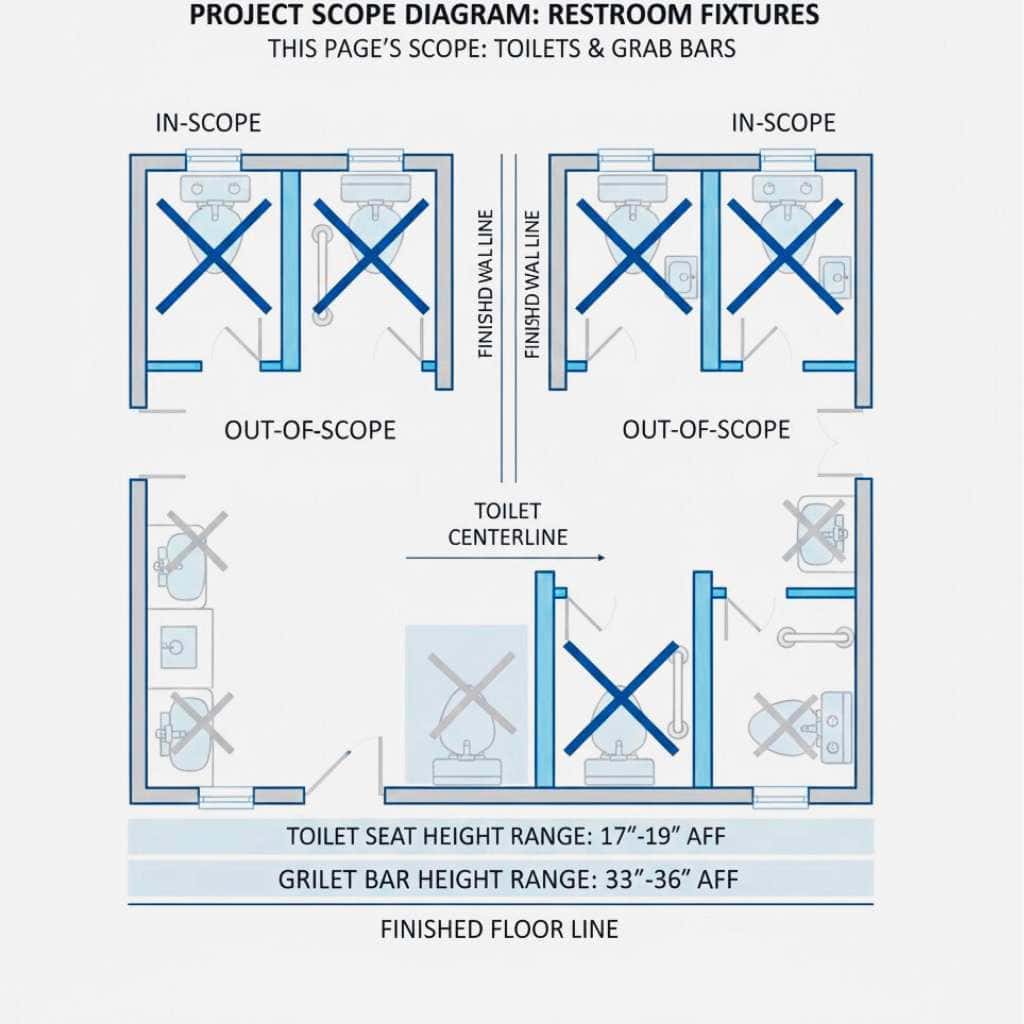
Before getting into measurements, it helps to be precise about scope. Accessibility standards are organized by element, and requirements that apply to one fixture do not automatically apply to others. This page focuses on a narrow set of rules so the explanations stay accurate and usable.
This page applies only to toilets and the grab bars required at those toilets. That includes toilet seat height, grab bar height, grab bar length, placement, clearance, and how those dimensions are measured in finished construction. The discussion is limited to toilets located in accessible toilet rooms or accessible toilet compartments, where these specific standards apply.
This page does not cover other restroom or site features, even though they are often discussed together in practice. Requirements for sinks or lavatories, toilet compartments and stalls, showers and bathing facilities, or circulation paths such as door clearances and routes are governed by separate sections of the standards and are evaluated using different criteria. Those elements are intentionally excluded here to avoid overlap and misapplication of rules.
Which Standards Control Toilet and Grab Bar Requirements in California
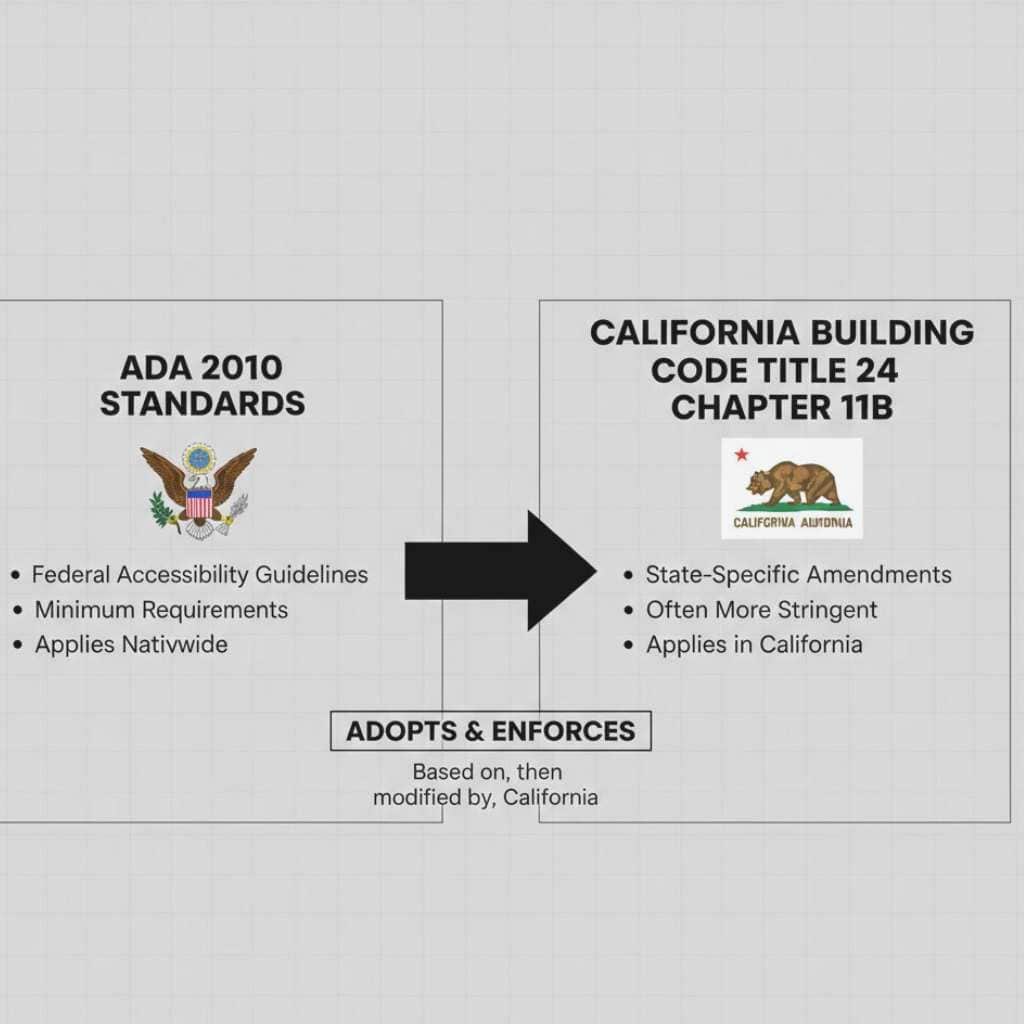
Before looking at specific dimensions, it is necessary to understand which standards actually control how toilet and grab bar requirements are interpreted in California. These requirements do not operate independently. They exist within a defined hierarchy that determines how measurements are evaluated and documented during inspection.
At the federal level, the 2010 ADA Standards for Accessible Design establish the baseline technical requirements for toilets and grab bars in places of public accommodation and commercial facilities. These standards define core elements such as toilet seat height, grab bar height, length, placement, and required clearances. These same standards are routinely applied to restrooms in retail shopping centers, where accessibility requirements must be evaluated consistently across multiple tenant spaces. They are written as measurable criteria, not design suggestions, and form the technical foundation used nationwide.
In California, those federal standards are adopted and enforced through the California Building Code, Title 24, Part 2, Chapter 11B. Chapter 11B incorporates the ADA requirements and places them within California’s building regulatory framework. During plan review and field inspection, Title 24 Chapter 11B functions as the controlling code, while the underlying ADA standards supply the technical basis for the measurements being evaluated. This distinction matters because inspections in California reference state code structure even when the dimensional requirements originate at the federal level.
ADA vs California Title 24 Requirements for Toilets and Grab Bars
When ADA and California requirements are compared side by side, most toilet and grab bar dimensions align closely. Both standards regulate the same fixtures and rely on defined measurement ranges rather than subjective judgment. Differences arise not from competing rules, but from how California applies and documents those rules within its enforcement system.
In most cases, the required heights, lengths, and placement of toilets and grab bars are the same under the ADA and Title 24. California generally adopts the federal measurements and reference points, which maintains consistency across jurisdictions. However, California applies these requirements through Title 24 Chapter 11B, which governs how conditions are reviewed, cited, and recorded during inspections. As a result, the same physical condition may be evaluated through a state code lens even though the underlying technical requirement comes from the ADA.
Understanding this relationship helps prevent misinterpretation. Relying on federal guidance alone without recognizing the state enforcement framework can lead to confusion about how inspection findings are documented in California. This article uses that combined framework to explain measurements as they are applied in practice.
Sources:
2010 ADA Standards for Accessible Design, Sections 604 and 609, U.S. Department of Justice.
California Building Code, Title 24, Part 2, Chapter 11B, Sections 11B-604 and 11B-609, California Department of General Services.
Toilet Location Context That Governs Applicable Requirements
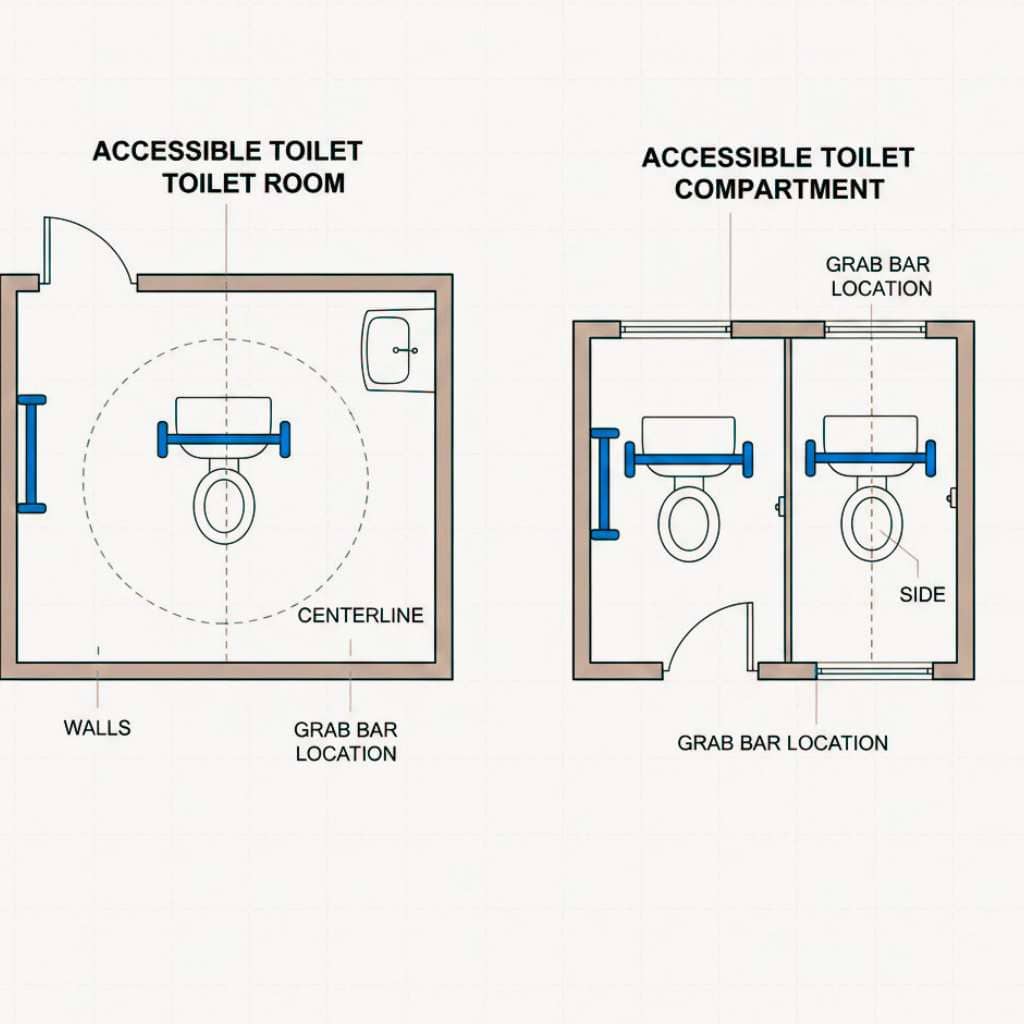
Before applying any height or placement rule, the location of the toilet has to be established. Accessibility standards do not treat all toilets the same.
Requirements for grab bars and related dimensions depend on whether the toilet is located in an accessible toilet room or within an accessible toilet compartment. This distinction commonly arises in shared-use restrooms in multifamily and HOA properties, where accessibility requirements typically apply to common areas rather than individual dwelling units. This distinction governs which rules apply and how they are interpreted during inspection.
An accessible toilet room is a room that contains a toilet and associated fixtures and is designed to meet accessibility requirements without subdividing the toilet into a separate stall or compartment. In this context, grab bar placement is evaluated based on the walls that serve the toilet directly. The required grab bars must be positioned relative to the toilet centerline and adjacent walls that define the usable space around the fixture.
An accessible toilet compartment, by contrast, is a defined enclosure within a multi-stall restroom. When a toilet is located inside a compartment, additional rules apply because the compartment walls establish fixed boundaries. Grab bar placement, length, and clearance are evaluated in relation to those compartment walls rather than the broader room. This is why compartment-specific provisions exist. The enclosure itself changes how the standards are applied.
Understanding this location context prevents misapplication of rules. Grab bar requirements that are appropriate for an accessible toilet room may not satisfy the standards when the same toilet is placed inside a compartment, and vice versa. Establishing where the toilet is located is therefore a necessary first step before measuring heights, lengths, or offsets.
Sources:
2010 ADA Standards for Accessible Design, Section 604 Toilet and Bathing Facilities, U.S. Department of Justice.
California Building Code, Title 24, Part 2, Chapter 11B, Section 11B-604 Water Closets and Toilet Compartments, California Department of General Services.
Measurement Reference Framework Used During Inspection
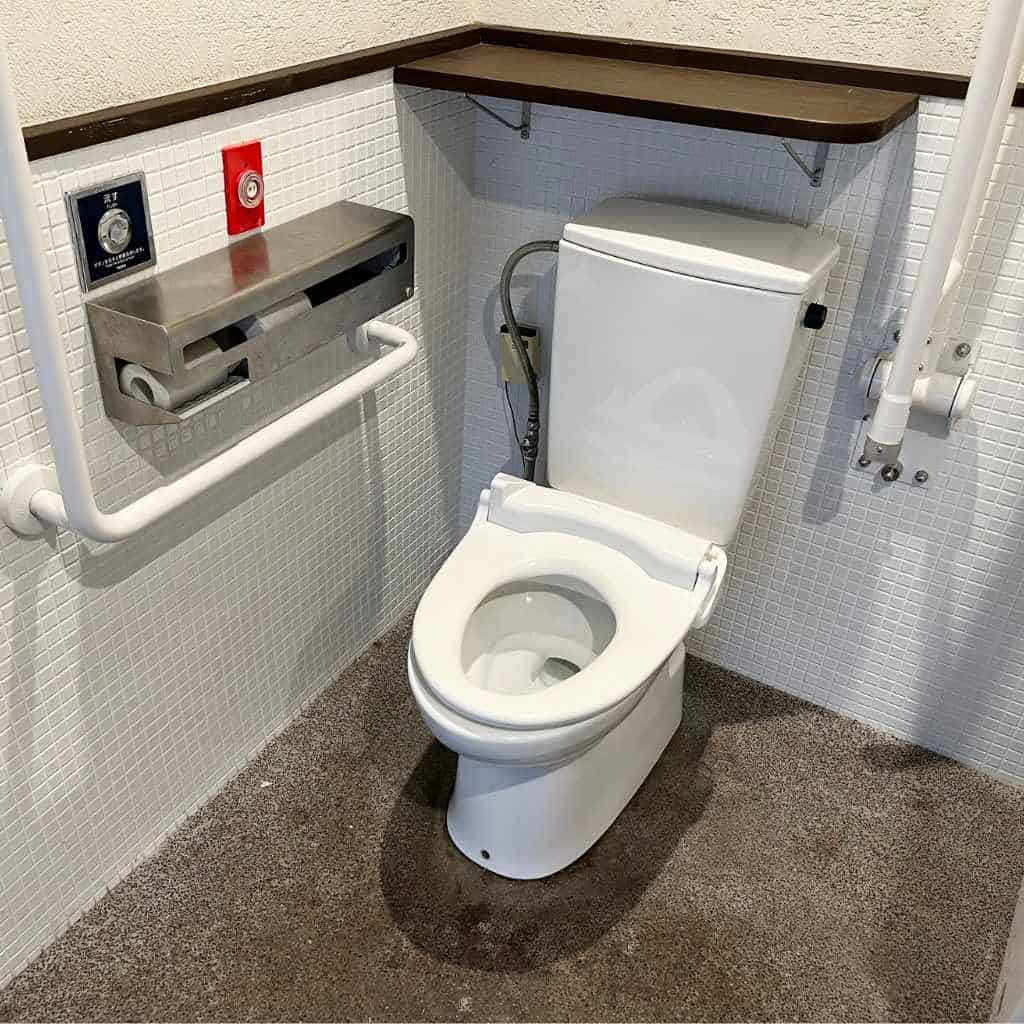
Before any height or placement requirement can be evaluated, inspectors establish a consistent set of reference points. Accessibility standards rely on defined measurement references so conditions can be assessed objectively. Without those reference points, the same physical condition could be interpreted differently from one inspection to another.
For toilets and grab bars, measurements are taken from the finished condition of the space, not from plans, specifications, or product documentation. The primary reference points used during inspection are the finished floor, the finished wall, and the toilet centerline. The finished floor refers to the completed walking surface, including any applied floor finishes. Heights for toilet seats and grab bars are measured vertically from this surface. The finished wall refers to the completed wall surface, not framing or backing, and is used when evaluating clearances and grab bar placement. The toilet centerline establishes a fixed horizontal reference used to determine where grab bars must begin, end, or align relative to the toilet.
This framework also explains why design intent and product labeling are not controlling. A toilet or grab bar may be marketed as meeting accessibility standards, but inspections evaluate the installed condition in the field. Variations in floor finishes, wall construction, or fixture placement can affect measured dimensions even when compliant products are used. For this reason, inspections document measurements as they exist at the time of evaluation, using the finished reference points defined by the standards.
Understanding these reference points is essential before reviewing any numeric requirements. All subsequent height, length, and placement rules in this guide rely on this same measurement framework.
Sources:
2010 ADA Standards for Accessible Design, Sections 104 Conventions, 604 Toilet and Bathing Facilities, and 609 Grab Bars, U.S. Department of Justice.
California Building Code, Title 24, Part 2, Chapter 11B, Sections 11B-104 Conventions, 11B-604 Water Closets and Toilet Compartments, and 11B-609 Grab Bars, California Department of General Services.
ADA Toilet and Grab Bar Requirements at a Glance
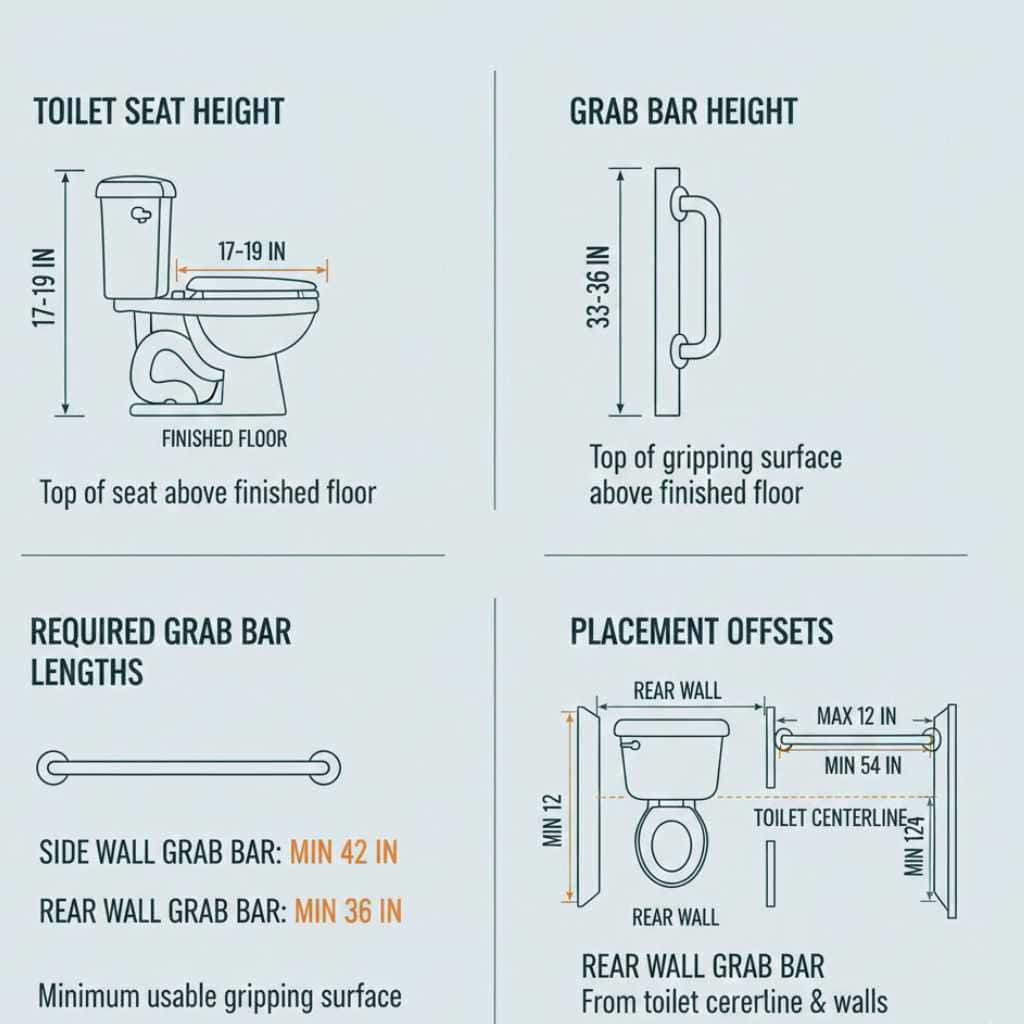
Once the measurement reference framework is established, the standards reduce to a defined set of numeric rules. This section brings those rules together in one place so the relationships between heights, lengths, and placement are easy to see before going into detailed explanations. All measurements below are taken from finished surfaces using the reference points described earlier.
Toilet seat height.
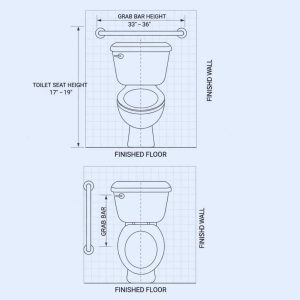
The top of the toilet seat must be 17 to 19 inches above the finished floor. The measurement is taken to the top of the seat, not the rim of the bowl. The standards rely on this range rather than a single dimension, which is why the finished floor reference matters when flooring thickness varies.
Grab bar height.
Grab bars at toilets must be mounted so the top of the gripping surface is 33 to 36 inches above the finished floor. This range applies consistently to both side and rear grab bars. Height is measured vertically from the finished floor to the top of the bar’s gripping surface.
Required grab bar lengths.
At least two grab bars are required at an accessible toilet:
Side wall grab bar: minimum 42 inches long
Rear wall grab bar: minimum 36 inches long
These minimum lengths ensure enough usable gripping surface for transfer and repositioning.
Placement offsets from the toilet centerline and walls.
Placement is evaluated using fixed horizontal references:
The side wall grab bar must be located no more than 12 inches from the rear wall and extend at least 54 inches from the rear wall.
The rear wall grab bar must extend at least 12 inches on one side of the toilet centerline and at least 24 inches on the other side.
These offsets are measured horizontally from the finished wall surfaces and the toilet centerline.
Clearance and mounting basics.
Grab bars must be installed with 1½ inches of clearance between the bar and the finished wall. They must also be securely mounted and capable of supporting 250 pounds of force applied in any direction. These requirements address both usability and structural performance, independent of the grab bar’s appearance or product labeling.
All dimensions listed above are evaluated using the finished floor, finished wall, and toilet centerline reference points described earlier, which is why identifying those reference surfaces correctly is necessary before validating any measurement.
Sources:
2010 ADA Standards for Accessible Design, Sections 604 Water Closets and Toilet Compartments and 609 Grab Bars, U.S. Department of Justice.
California Building Code, Title 24, Part 2, Chapter 11B, Sections 11B-604 and 11B-609, California Department of General Services.
ADA Toilet Seat Height Requirements
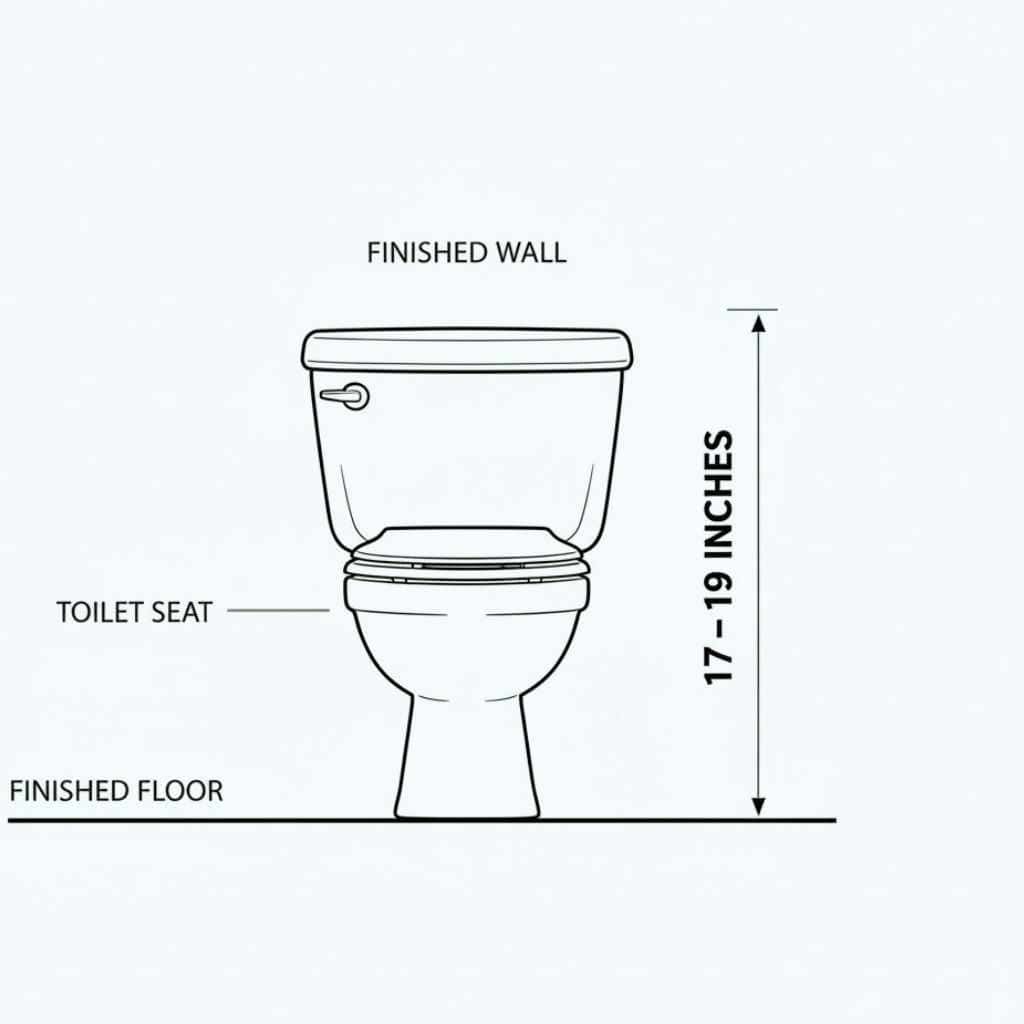
Toilet seat height is one of the most commonly checked dimensions during an accessibility inspection because it directly affects transfer and usability. The standards define this requirement using a measured range rather than a single fixed dimension, which is why accurate reference points matter.
The required toilet seat height is 17 to 19 inches above the finished floor, measured to the top of the toilet seat. This range applies to accessible toilets in both accessible toilet rooms and accessible toilet compartments. The standard does not establish a preferred height within the range. Any measurement that falls within the stated limits is evaluated against the requirement.
It is important to note that the standards do not define an additional tolerance outside this range. The requirement is expressed as a minimum and maximum dimension. During inspection, the measured height is documented based on the finished condition at the time of evaluation rather than design intent or product specifications.
Sources:
2010 ADA Standards for Accessible Design, Section 604.4 Water Closet Height, U.S. Department of Justice.
California Building Code, Title 24, Part 2, Chapter 11B, Section 11B-604.4 Water Closet Height, California Department of General Services.
How Toilet Seat Height Is Measured
Understanding how toilet seat height is measured helps prevent common errors when reviewing drawings or field conditions. The standards rely on a specific measurement method so that evaluations are consistent across different facilities and installations.
Toilet seat height is measured vertically from the finished floor to the top surface of the toilet seat, with the seat in the down position. The finished floor includes any applied flooring material, such as tile or resilient flooring, and serves as the baseline reference. The measurement is taken to the highest point of the seat surface, not to the rim of the bowl or the fixture body.
This method explains why changes in floor finishes or seat thickness can affect the measured height, even when the same toilet model is used. Inspections document the installed condition as measured from the finished reference surface, not the intended height shown on plans.
Measuring to the rim of the bowl instead of the top of the seat is a common source of error and can result in a documented height that does not reflect how the standard is applied during inspection.
Sources:
2010 ADA Standards for Accessible Design, Sections 104 Conventions and 604.4 Water Closet Height, U.S. Department of Justice.
California Building Code, Title 24, Part 2, Chapter 11B, Sections 11B-104 Conventions and 11B-604.4 Water Closet Height, California Department of General Services.
Grab Bar Height Requirements at Toilets
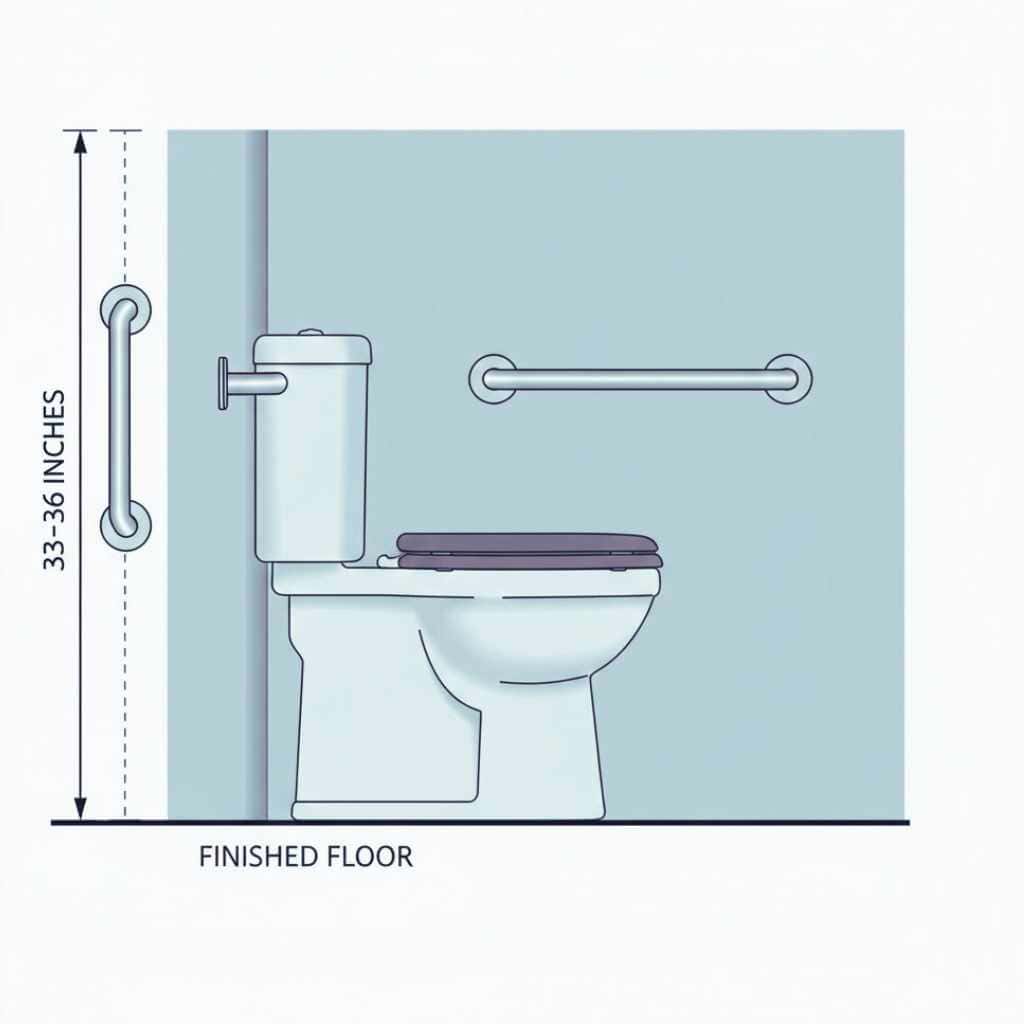
Grab bar height is regulated to ensure consistent reach and support during transfer and repositioning. Unlike placement length or offset rules, height requirements apply uniformly to all required grab bars at an accessible toilet, regardless of whether the bar is mounted on the side wall or rear wall.
Both the side grab bar and the rear grab bar must be installed so the top of the gripping surface is between 33 and 36 inches above the finished floor. This height range applies to all required toilet grab bars and is evaluated as a vertical measurement. The standards do not differentiate height requirements based on wall location, toilet type, or room configuration.
The standards also do not allow a tolerance outside the stated range. Grab bars are evaluated against the minimum and maximum dimensions as written. During inspection, the documented height reflects the installed condition at the time of evaluation, not design intent or manufacturer specifications. Consistency within the defined range is what governs how the condition is recorded.
Sources:
2010 ADA Standards for Accessible Design, Section 609.4 Position of Grab Bars, U.S. Department of Justice.
California Building Code, Title 24, Part 2, Chapter 11B, Section 11B-609.4 Position of Grab Bars, California Department of General Services.
How Grab Bar Height Is Measured
Understanding how grab bar height is measured helps prevent errors that occur when reference points are misunderstood or inconsistently applied. The standards rely on a single, repeatable measurement method to maintain consistency across inspections.
Grab bar height is measured vertically from the finished floor to the top of the grab bar’s gripping surface. The finished floor includes all applied floor finishes and serves as the baseline reference. The gripping surface refers to the portion of the bar intended to be grasped, not mounting brackets, flanges, or decorative covers.
This measurement method explains why changes in floor finishes or grab bar diameter can affect documented height. Inspections record the measured dimension as it exists in the finished condition, using the defined reference points rather than nominal product dimensions.
Sources:
2010 ADA Standards for Accessible Design, Sections 104 Conventions and 609.4 Position of Grab Bars, U.S. Department of Justice.
California Building Code, Title 24, Part 2, Chapter 11B, Sections 11B-104 Conventions and 11B-609.4 Position of Grab Bars, California Department of General Services.
Required Grab Bar Lengths and Placement at Toilets
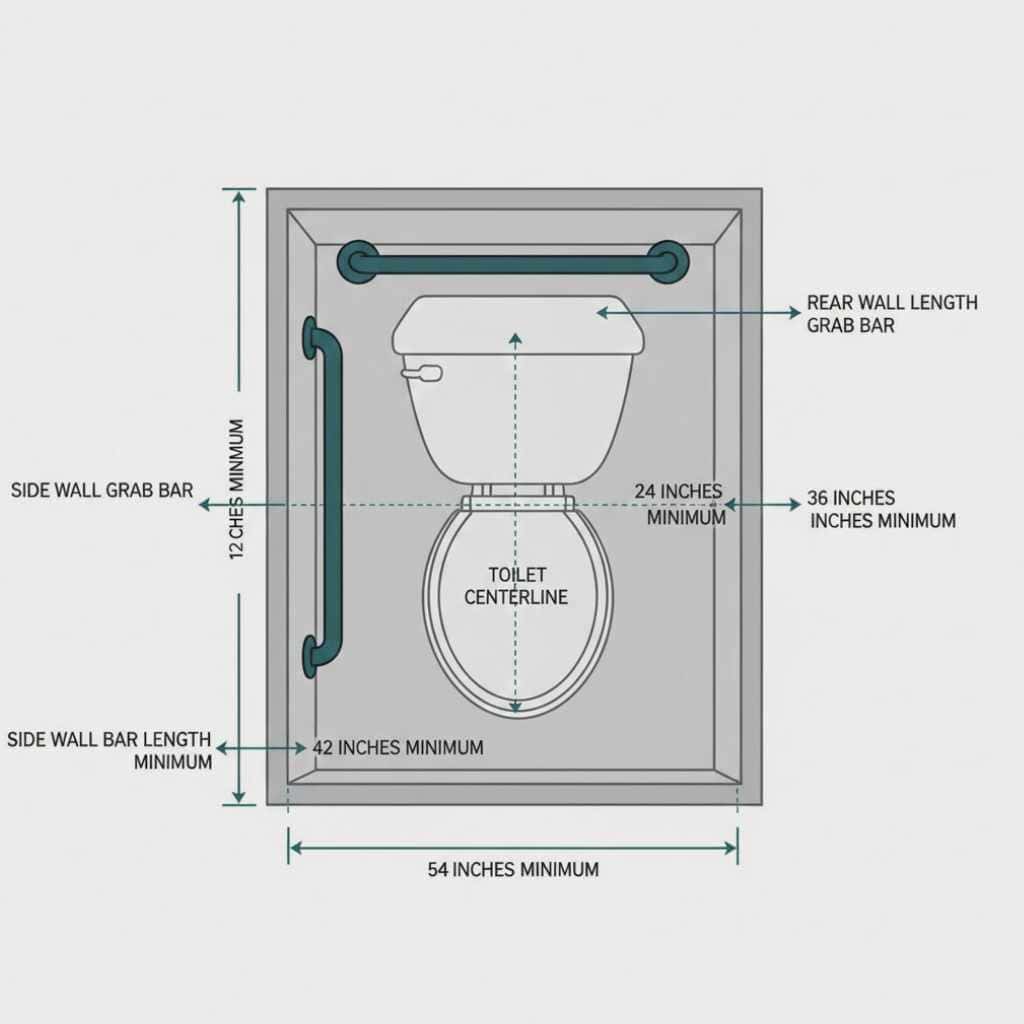
Grab bar installation is evaluated not only by height, but by whether the required bars are long enough and positioned in relation to the toilet itself. The standards use fixed reference points so placement can be measured consistently, regardless of room size or layout. This section focuses on the minimum lengths and required offsets that determine whether grab bars serve their intended function.
For an accessible toilet, two grab bars are required: one on the side wall and one on the rear wall. Each bar has its own length and placement rules, and both are evaluated in relation to the toilet centerline and adjacent finished walls. These placement relationships are frequently evaluated in restrooms in entertainment venues, where compartment dimensions and wall boundaries directly affect grab bar length and offset measurements.
The side wall grab bar must be a minimum of 42 inches long. It is positioned on the wall beside the toilet and must be located no more than 12 inches from the rear wall, measured horizontally. From that rear wall reference, the bar must extend at least 54 inches forward. This ensures continuous gripping surface alongside the toilet for transfer and repositioning.
The rear wall grab bar must be a minimum of 36 inches long. It is centered on the wall behind the toilet and is measured horizontally from the toilet centerline. The bar must extend at least 12 inches on one side of the centerline and at least 24 inches on the other side. This asymmetric requirement reflects how the rear bar is used during approach and transfer.
All length and placement measurements are taken from finished wall surfaces using horizontal reference lines. Product dimensions, mounting intent, or visual alignment do not control how these requirements are evaluated. The installed condition is measured as it exists in the field, using the defined reference points. Measuring grab bar length from decorative end caps or mounting covers rather than from the usable gripping surface can change the documented length and does not reflect how the standard is applied during inspection.
Sources:
2010 ADA Standards for Accessible Design, Section 604.5 Grab Bars, U.S. Department of Justice.
California Building Code, Title 24, Part 2, Chapter 11B, Section 11B-604.5 Grab Bars, California Department of General Services.
Clearance Requirements Around Toilet Grab Bars
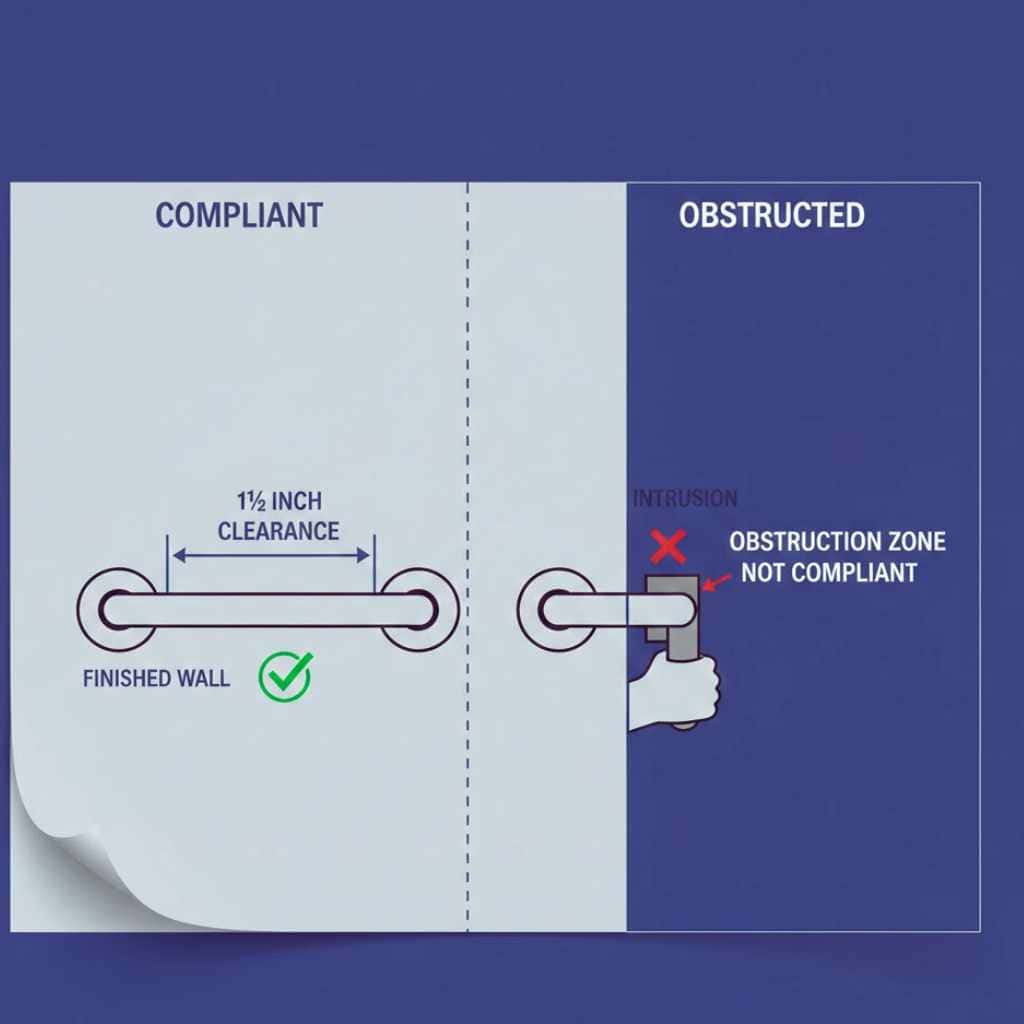
Clearance around grab bars is evaluated separately from height, length, and placement. Even when a grab bar is installed at the correct height and location, it must remain usable along its full gripping surface. For that reason, the standards define a required clearance zone and restrict what can occupy that space.
Grab bars must be installed with a minimum clearance of 1½ inches between the grab bar and the finished wall surface. This clearance is measured perpendicular to the wall, from the finished wall surface to the nearest edge of the grab bar’s gripping surface. The requirement applies along the full usable length of the bar and is intended to allow the bar to be grasped securely without interference from the wall.
The clearance zone around a grab bar must also remain free of obstructions. Elements such as dispensers, shelves, trim, or accessories may not project into the required clearance or reduce the usable gripping surface. Adjacent fixtures are evaluated based on how they interact with the grab bar in its installed condition, not on whether the bar itself meets height or length requirements. If an object intrudes into the clearance zone, the grab bar may not function as intended even though other dimensional criteria are met.
During inspection, clearance is documented as it exists in the finished condition. Accessories or fixtures added after construction are evaluated the same way as original installations if they affect the required clearance around the grab bar, because the standards apply to the condition present at the time of evaluation.
Sources:
2010 ADA Standards for Accessible Design, Section 609.3 Spacing, U.S. Department of Justice.
California Building Code, Title 24, Part 2, Chapter 11B, Section 11B-609.3 Spacing, California Department of General Services.
Structural and Load-Bearing Requirements for Toilet Grab Bars
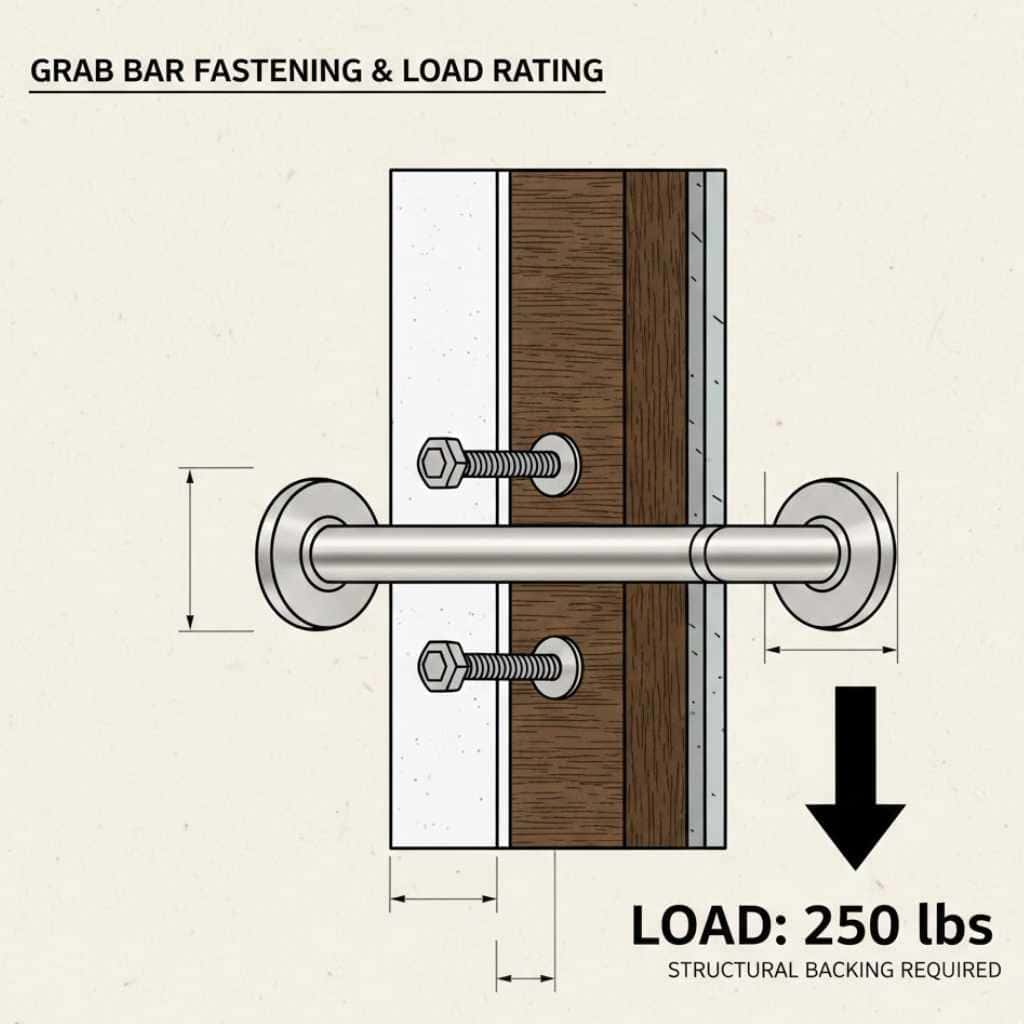
Grab bar installation is evaluated not only by where the bar is placed, but by how it is supported within the wall. The accessibility standards treat structural support as a separate requirement because a grab bar must be able to resist force during use, regardless of whether its height or placement is correct.
Grab bars must be securely attached to structural backing or framing capable of supporting the required loads. The standards do not mandate a specific backing material or wall assembly. Instead, they establish a performance expectation. Whether the wall is constructed with wood studs, metal studs, masonry, or another approved system, the attachment method must allow the grab bar to resist applied forces without failure.
From a load perspective, grab bars are required to withstand a force of 250 pounds applied in any direction. This requirement applies to the grab bar as an installed assembly, including fasteners, anchors, and the supporting wall structure. It is not satisfied by product ratings alone. The evaluation is based on how the grab bar is mounted in the finished condition, not on manufacturer literature or design intent.
These structural requirements operate independently of dimensional rules. A grab bar may meet height, length, and clearance requirements but still be evaluated separately if the mounting or backing does not appear capable of resisting the required load. During inspection, visible movement, inadequate anchoring, or insufficient backing may be documented even when all dimensional criteria are met.
Sources:
2010 ADA Standards for Accessible Design, Section 609.8 Structural Strength, U.S. Department of Justice.
California Building Code, Title 24, Part 2, Chapter 11B, Section 11B-609.8 Structural Strength, California Department of General Services.
Toilet and Grab Bar Dimensional Reference Table (California)
| Requirement Category | Element Measured | Required Dimension | Measurement Reference Point | Applies When | Applicable Code Section |
|---|---|---|---|---|---|
| Toilet Fixture Height | Toilet seat height | 17 inches minimum to 19 inches maximum | Top of toilet seat to finished floor | Accessible toilet rooms or compartments are required | ADA 2010 §604.4; CBC 11B-604.4 |
| Grab Bar Height | Side and rear grab bars | 33 inches minimum to 36 inches maximum | Top of gripping surface to finished floor | Grab bars are required at accessible toilets | ADA 2010 §609.4; CBC 11B-609.4 |
| Grab Bar Length | Side wall grab bar | 42 inches minimum | Length of usable gripping surface | Side wall grab bar is required | ADA 2010 §604.5.1; CBC 11B-604.5.1 |
| Grab Bar Placement | Side wall grab bar offset | Located no more than 12 inches from rear wall and extending at least 54 inches from rear wall | Rear wall face to start and end of gripping surface | Side wall grab bar is required | ADA 2010 §604.5.1; CBC 11B-604.5.1 |
| Grab Bar Length | Rear wall grab bar | 36 inches minimum | Length of usable gripping surface | Rear wall grab bar is required | ADA 2010 §604.5.2; CBC 11B-604.5.2 |
| Grab Bar Placement | Rear wall grab bar offset | Extends at least 12 inches on one side of toilet centerline and 24 inches on the other | Toilet centerline to gripping surface ends | Rear wall grab bar is required | ADA 2010 §604.5.2; CBC 11B-604.5.2 |
| Grab Bar Clearance | Wall clearance behind grab bar | 1.5 inches minimum | Finished wall surface to back of grab bar | Grab bars are installed | ADA 2010 §609.3; CBC 11B-609.3 |
| Grab Bar Structure | Load resistance | Able to support 250 pounds applied in any direction | Structural attachment point, not finish material | Grab bars are installed | ADA 2010 §609.8; CBC 11B-609.8 |
Notes on Use
All dimensions are evaluated in finished condition, not based on drawings, product literature, or design intent.
Grab bar lengths are measured along the usable gripping surface, not decorative end caps or flanges.
Applicability depends on whether an accessible toilet room or compartment is required under the project scope and occupancy.
Standards Referenced
2010 ADA Standards for Accessible Design, U.S. Department of Justice
California Building Code, Title 24, Part 2, Chapter 11B
Common Toilet and Grab Bar Conditions Documented During Inspection in California
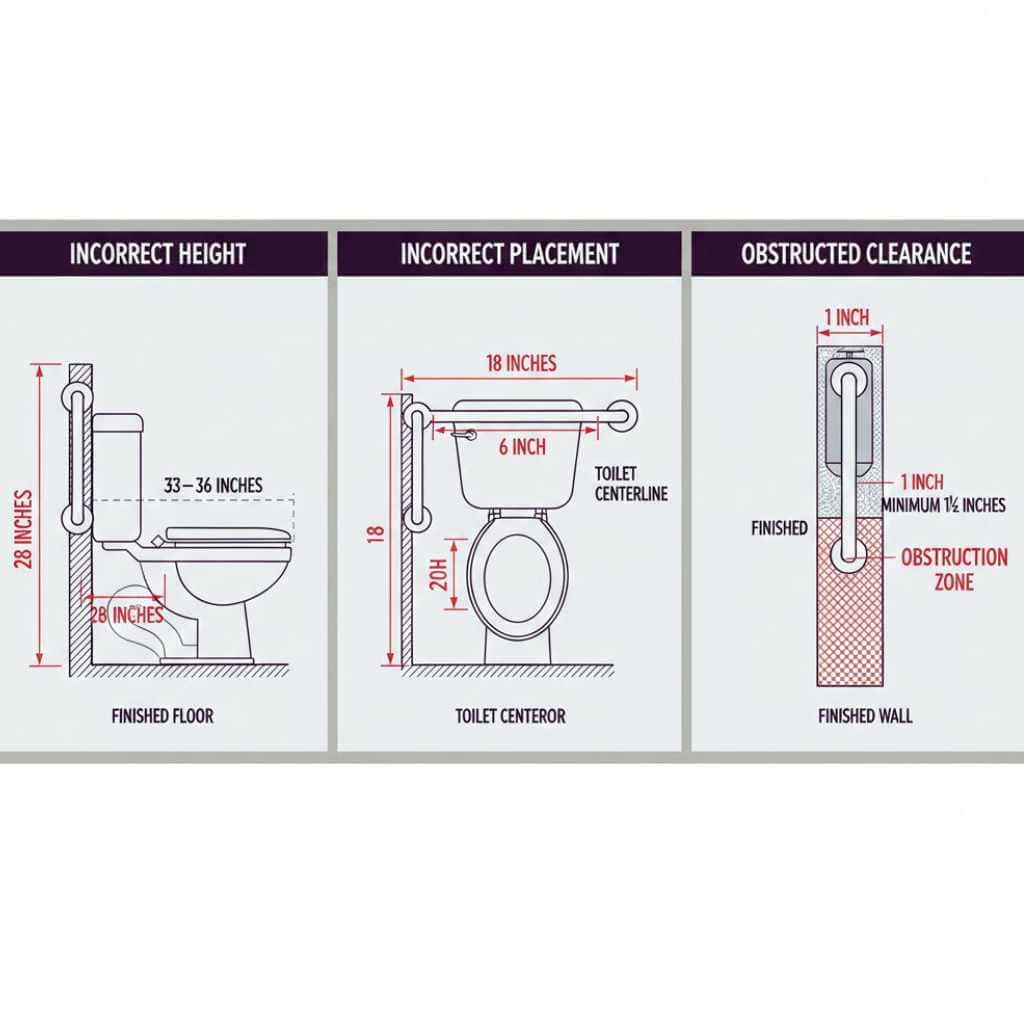
Accessibility inspections often identify recurring conditions related to toilet fixtures and grab bars. These are not judgments about intent, quality, or outcomes. They are observations recorded against specific dimensional and structural criteria found in the applicable accessibility standards. Understanding these patterns helps explain why inspections focus closely on measurement reference points, installation context, and finished conditions rather than product labels or design assumptions.
Height Conditions Outside the Referenced Range
One commonly documented condition involves toilet seat height or grab bar mounting height falling outside the referenced dimensional ranges when measured in the field. This typically occurs when measurements are taken from an incorrect reference surface, such as subfloor instead of finished floor, or from decorative components rather than the functional surface defined by the standards. Because height requirements are expressed as ranges, small differences in reference points can change how a condition is recorded during inspection.
Grab Bar Length and Placement Conditions
Another frequently documented condition relates to grab bar length or placement that does not correspond to the required reference locations. In many cases, the bar itself appears substantial and well mounted, but the usable gripping length or the relationship to the toilet centerline does not match the dimensional criteria in the standards. These conditions are evaluated based on measured distances and clear definitions of where length begins and ends, not on visual symmetry or perceived adequacy.
Clearance and Mounting Conditions
Clearance and mounting conditions are also regularly documented during inspections. Grab bars may be correctly positioned in height and length yet have adjacent elements that occupy the clearance zone required for use. In other cases, bars are installed into finishes without verified structural backing, which affects how load resistance is evaluated. These observations are recorded independently because clearance, structural support, and load resistance are separate requirements, each with its own measurement or verification method.
Why These Patterns Appear Consistently
These recurring conditions are not unusual. They often arise from differences between design intent and finished construction, late-stage accessory additions, or misunderstandings about how standards define reference points. Inspections document how the installation exists at the time of evaluation, using cited criteria, measured dimensions, and observable construction conditions.
Sources
2010 ADA Standards for Accessible Design, Sections 604 and 609
California Building Code, Title 24, Chapter 11B, Sections 11B-604 and 11B-609
How CASp Inspectors and DSA Apply Toilet and Grab Bar Requirements
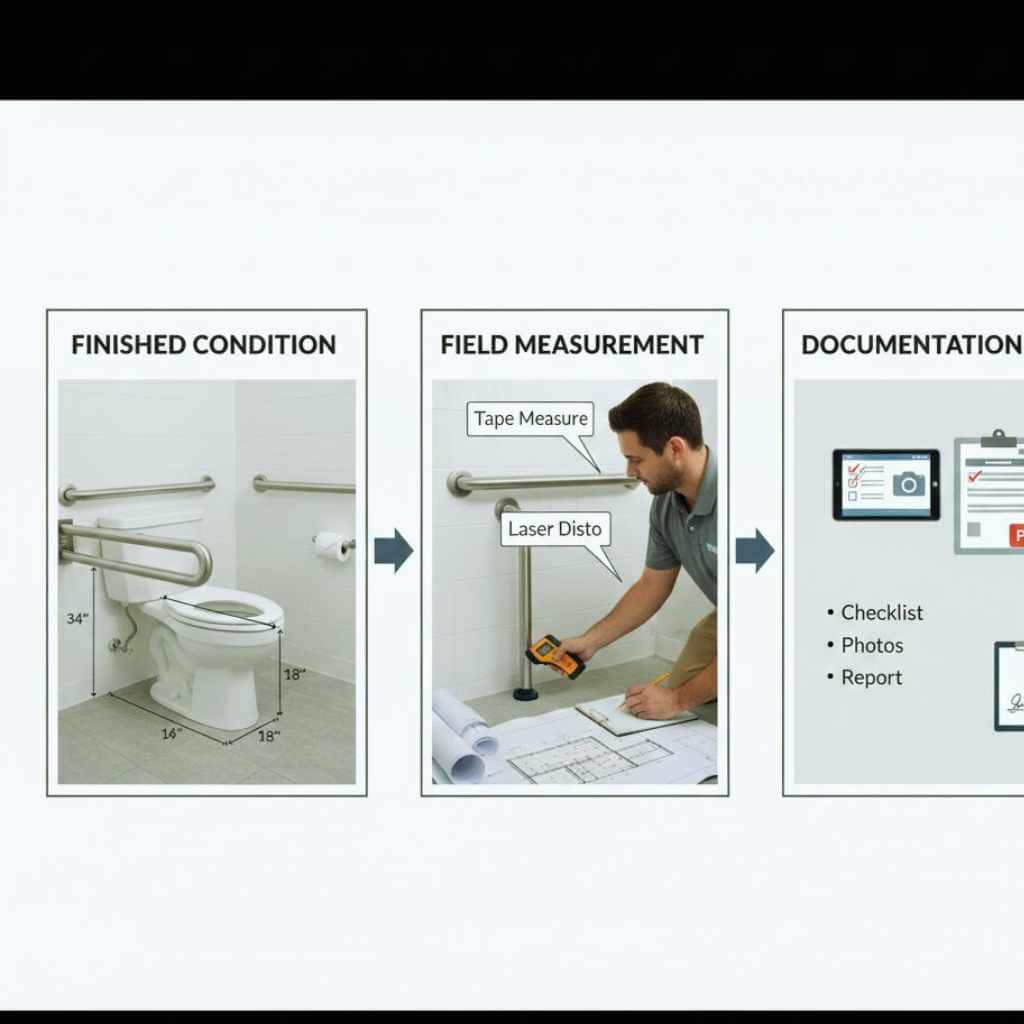
Certified Access Specialists and the California Division of the State Architect apply toilet and grab bar requirements by evaluating finished, built conditions against the standards that apply to the facility type and jurisdiction. This process is not about design intent, drawings, or product specifications. It is about what exists in the space at the time of review and how that condition aligns with the referenced criteria.
CASp inspections document observed conditions using defined measurement reference points such as the finished floor, finished wall, and the usable gripping surface of grab bars. Measurements are taken in the field, using the standards in effect for the project, and recorded as they exist. The role of the inspector is to identify and describe those conditions, not to approve construction, direct corrections, or predict outcomes beyond the scope of the evaluation.
DSA reviews rely on the same standards framework but occur within a plan review or state oversight context, depending on the facility. In both cases, the underlying mechanism is consistent: applicable standards establish dimensional and placement criteria, finished conditions are measured against those criteria, and the results are documented. Differences between required criteria and observed conditions are noted as findings, without assigning intent, cause, or remedy.
This distinction matters because many misunderstandings arise when design assumptions or manufacturer dimensions are substituted for field measurements. Inspection and review processes are grounded in what is built, not what was planned or labeled.
Sources:
2010 ADA Standards for Accessible Design, Sections 604 and 609
California Building Code, Title 24, Chapter 11B
California Division of the State Architect Accessibility Review Program Documentation
ADA Toilet and Grab Bar Height Standards in California
ADA toilet and grab bar height requirements in California define how specific restroom elements are measured, evaluated, and documented under adopted accessibility standards. These requirements are not general design guidelines and they do not operate in isolation. They apply within a defined scope, depend on location and context, and are assessed based on finished conditions using standardized reference points.
Throughout this page, the focus has remained narrow by design. Toilet seat height, grab bar height, grab bar length, placement, clearance, and structural support are governed by precise criteria set out in the 2010 ADA Standards for Accessible Design and California Building Code Title 24, Chapter 11B. Those criteria are measurable, repeatable, and evaluated as they exist in the built environment, not as they were intended or specified.
Understanding these requirements at an entity level helps prevent common sources of confusion. Differences between federal and California standards, assumptions based on product literature, or measurements taken from the wrong reference point often lead to inconsistent interpretations. Grounding decisions in the actual standards language and measurement framework provides clarity without overstating outcomes or implying conclusions beyond what an evaluation can support.
This topic sits within a larger accessibility system that includes other fixtures, circulation elements, and use-type considerations. Those elements follow their own criteria and should be evaluated separately. Keeping toilet and grab bar requirements clearly bounded allows them to be applied accurately, documented consistently, and understood in their proper regulatory context.