ADA hotel bathroom compliance means meeting all the required dimensions, fixtures, and clearances that allow guests with disabilities to safely use the restroom in an accessible guest room. In California, that standard isn’t just the federal ADA. It includes California’s stricter Title 24 Chapter 11B rules — and they’re specific down to the inch.
Here’s the thing: hotel inspections fail all the time because someone skipped a transfer-type shower seat, misaligned a grab bar, or didn’t provide the right clearance at the toilet. This isn’t theoretical. If you’re a hotel owner, architect, contractor, or CASp inspector, you need to know exactly what’s required in accessible guest bathrooms no guesswork.
This guide walks through what every compliant hotel bathroom must include under California law: shower configurations, turning space, grab bar specs, door swing limits, fixture controls, and more. If it’s not compliant, it doesn’t pass.
Key Compliance Takeaways for Hotel Bathrooms in California
Accessible bathrooms are mandatory in both mobility and communication guest room types under federal ADA and California Title 24.
Toilets, showers, and sinks must meet exact clearance, mounting height, and reach range specs — there’s no room for close enough.
California Title 24 is stricter than federal ADA in several key areas, including shower seat size, door clearance, and grab bar placement.
CASp inspectors verify measurement accuracy down to the inch — misplacing a grab bar by an inch can trigger a violation.
Details matter: door swing direction, faucet handle location, mirror height, and paper dispenser reach are all inspected.
Safe harbor protections don’t cover everything. If you’re altering or upgrading, 2019 CBC rules likely apply not older standards.
Who Must Follow ADA Hotel Bathroom Requirements in California
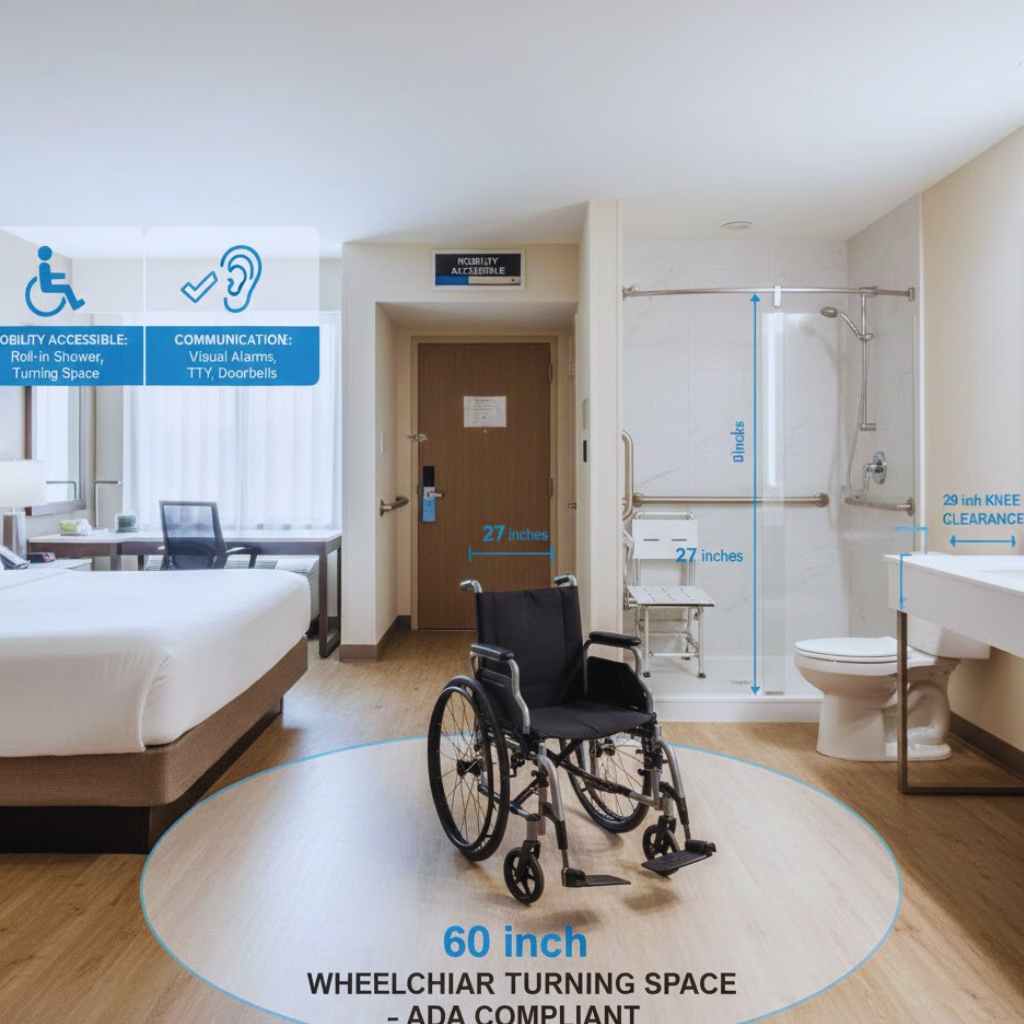
ADA hotel bathroom rules apply to all facilities classified as public accommodations which includes nearly every hotel, motel, and short-term rental operating in California. These requirements aren’t optional and don’t scale down based on size, price, or age of the building. The legal thresholds are clearly defined under the 2010 ADA Standards and Title 24 of the California Building Code.
Let’s break down who’s legally responsible, what qualifies as an accessible room, and how many accessible guest units are required by law.
Do All Hotels in California Need ADA-Compliant Bathrooms?
Yes. If your facility rents rooms to the public, ADA rules apply.
Hotels, motels, inns, extended stays, boutique lodgings, and even bed-and-breakfasts fall under the ADA’s definition of places of lodging. This places them squarely within the category of public accommodations, meaning full compliance with ADA and California accessibility rules is required.
This includes:
Chain hotels and franchises
Independently owned motels or roadside inns
Converted residential homes operating as inns
Corporate housing facilities used for short-term stays
There is no exemption based on number of rooms, rate tier, or ownership model.
What Counts as an Accessible Guest Room Under the ADA?
An accessible guest room is one that meets the design requirements for mobility or communication features or both.
Under ADA Section 806, accessible rooms are classified into three categories:
Mobility-accessible rooms
These include features like a compliant roll-in shower, clear floor space around fixtures, and accessible routes within the room.Communication-accessible rooms
These rooms must include visual alarms, notification devices for doors and phones, and accessible telephone features.Dual-equipped rooms
These rooms include both mobility and communication features. Often used to meet both quotas with fewer total rooms.
Room types must also be distributed across different classes of accommodations meaning accessible rooms can’t all be on the ground floor or only in economy units.
Communication Accessible Features Inside Hotel Bathrooms
Communication accessible guest rooms are often treated as a technology checklist. That approach leads to missed violations inside bathrooms.
In communication accessible rooms, bathrooms must support guests with hearing impairments. When alarms are provided, visual notification devices must be visible from the bathroom area. Inspectors verify that visual alarms can be perceived while the bathroom is in use and are not obstructed or located only in the sleeping area.
Hotels frequently pass mobility checks but fail communication accessibility because the bathroom was overlooked. Visual alarms that are not visible from inside the bathroom or are blocked by walls or doors do not meet compliance expectations.
This issue appears in real complaints. Guests document that they could not perceive alarms while using the bathroom. That becomes an unequal access claim rather than a technical deficiency.
Why this matters. Communication accessibility is enforced under the same civil rights framework as mobility access. Missing or poorly located visual alarms can invalidate a room’s communication accessible designation.
How Many Accessible Guest Rooms Are Required by Hotel Size?
The number of required accessible rooms depends on the total guest room count.
Section 224 of the 2010 ADA Standards lays out clear minimums. Here’s how it breaks down:
| Total Rooms in Facility | Required Mobility Rooms | Required Communication Rooms |
|---|---|---|
| 1–25 | 1 | 2 |
| 26–50 | 2 | 4 |
| 51–75 | 3 | 7 |
| 76–100 | 4 | 9 |
| 101–150 | 5 | 12 |
| 151–200 | 6 | 14 |
| 201–300 | 7 | 17 |
| 301–400 | 8 | 20 |
| 401–500 | 9 | 22 |
| 501–1000 | 2% of total | 5% of total |
| 1001+ | 20 + 1 for each 100 >1000 | 50 + 3 for each 100 >1000 |
Accessible rooms must also match the range of room types offered meaning if a hotel has suites, kings, and doubles, some of each must be accessible.
Do Boutique Inns or Older Motels Have Exceptions?
Some facilities qualify for limited exceptions but relying on that is risky without a CASp evaluation.
Here’s what’s actually allowed:
Safe harbor provision
If an element complied with the 1991 ADA Standards and hasn’t been altered since, it may not need to be updated. But this only applies to elements that were compliant under the older standard.Historic buildings exemption
Applies only when full compliance would threaten or destroy the historic integrity of the structure. Even then, alternative compliance methods are still required.
Real talk: Many older properties assume they’re exempt until they get flagged during an inspection or complaint. We’ve seen properties lose out on government bookings or face complaints because their ADA room had a grab bar but no proper turning radius.
If your property hasn’t been reviewed under current ADA and California Title 24 standards, you should assume full compliance is required.
When Bathroom Renovations Trigger Full ADA and Title 24 Compliance
Not every repair triggers a full accessibility upgrade, but many hotel renovations do. This distinction is often misunderstood and frequently cited in enforcement actions.
Routine maintenance such as replacing a shower valve or repairing tile does not automatically require full compliance updates. Alterations are different. When a bathroom renovation affects layout, usability, or fixture placement, accessibility requirements apply to the altered elements.
Once an element is altered, it must comply with current ADA standards and California Title 24. This includes fixtures, clearances, reach ranges, controls, and the accessible route into the bathroom. In some cases, additional path of travel upgrades may also be required depending on the scope of work.
Safe harbor does not automatically protect older conditions. It only applies to elements that complied with the 1991 ADA Standards and have not been altered. Once an element is modified, safe harbor no longer applies to that element.
Why this matters. Many hotel lawsuits begin after renovations. Photos show new finishes paired with noncompliant layouts. Inspectors and courts treat that as a missed compliance obligation, not a legacy condition.
Exact ADA Requirements for Hotel Guest Room Bathrooms in California
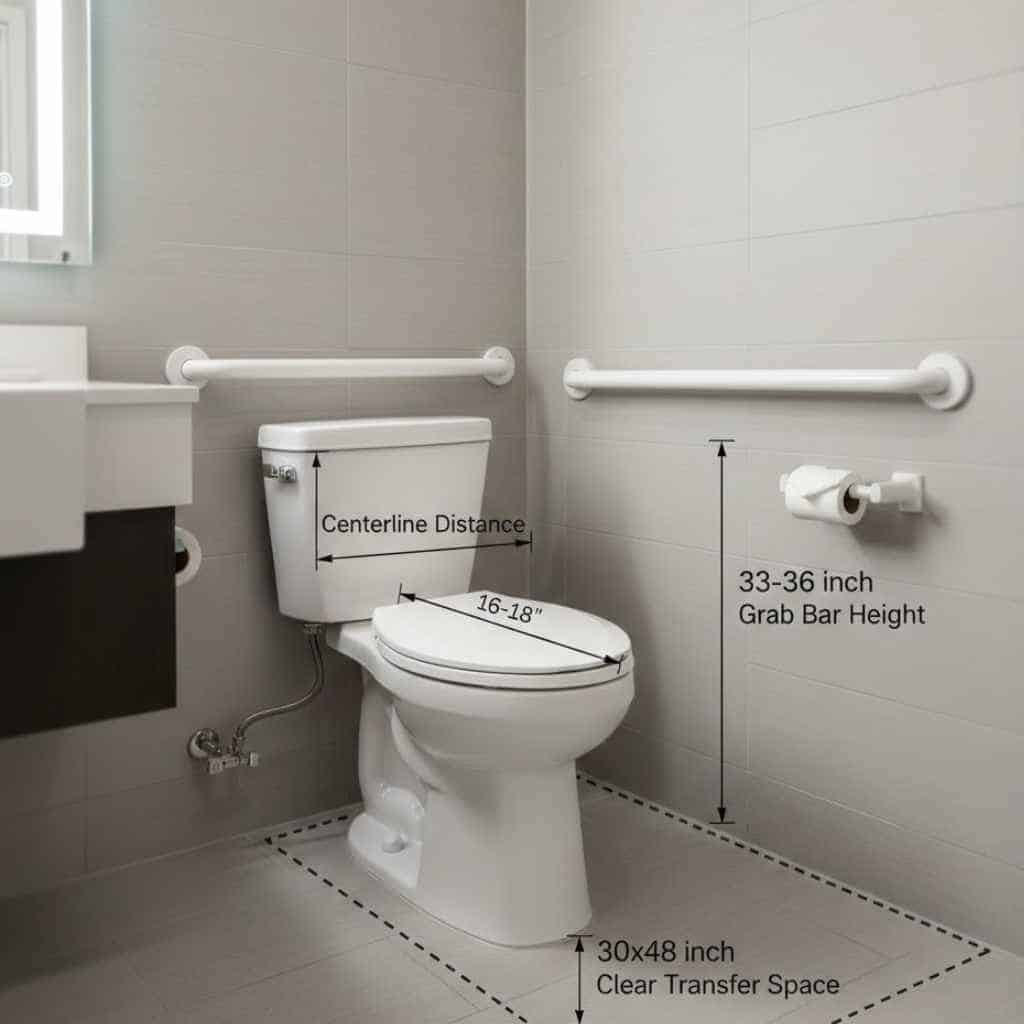
This is where inspections are won or lost. Hotel bathroom failures almost never come from missing features. They come from features installed a few inches off, placed in the wrong order, or blocked by door swings and fixtures that looked fine on drawings. Inspectors measure everything. So should you.
Each subsection below explains what inspectors focus on first, why hotels fail here, and the exact measurements that matter under the ADA 2010 Standards and California Title 24.
Toilet Clearance, Mounting, and Grab Bar Placement
Toilet layout is one of the most common failure points in accessible guest rooms. The issue is rarely the toilet itself. It is spacing, alignment, or grab bars installed for appearance instead of function.
Inspectors check whether a guest using a wheelchair can transfer safely from either side without obstruction. If the clearance or grab bars are off, the room does not pass, even if everything else looks compliant.
Exact measurements inspectors verify
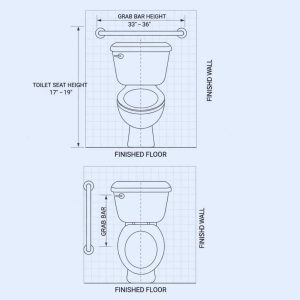
Toilet centerline must be 16 to 18 inches from the adjacent side wall.
Toilet seat height must be 17 to 19 inches measured to the top of the seat.
Clear floor space beside the toilet must allow a side transfer without obstruction.
Side grab bar
Minimum 42 inches long
Mounted 33 to 36 inches above the finished floor
Located behind the toilet front edge and extending toward the rear wall
Rear grab bar
Minimum 36 inches long
Mounted 33 to 36 inches above the finished floor
Centered on the toilet
Common hotel failure: rear grab bar too short or side grab bar shifted forward to avoid towel dispensers. Inspectors do not accept functional excuses.
Shower Types and Required Fixtures
Hotels get into trouble when the wrong shower type is installed in the wrong room. Mobility units require specific shower configurations. Mixing features between roll in and transfer showers without meeting all requirements causes automatic failure.
Inspectors look at shower size, seat placement, control location, and approach clearance as a system, not as individual parts.
Exact measurements inspectors verify
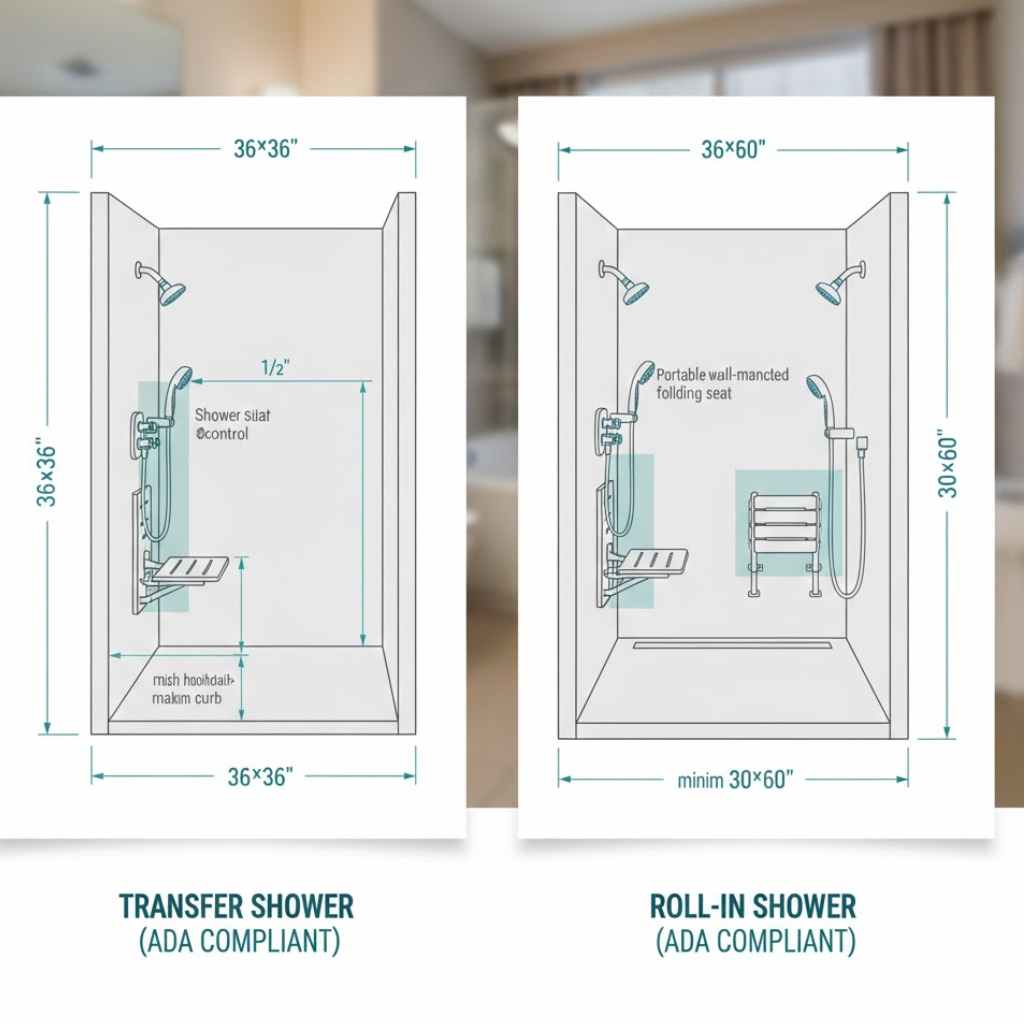
Transfer type shower
Interior size 36 by 36 inches
Fixed seat on the wall opposite the controls
Clear opening aligned for side transfer
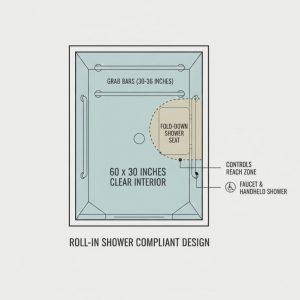
Roll in shower
Minimum clear size 60 by 30 inches
No curb
Controls and shower spray reachable from a seated position
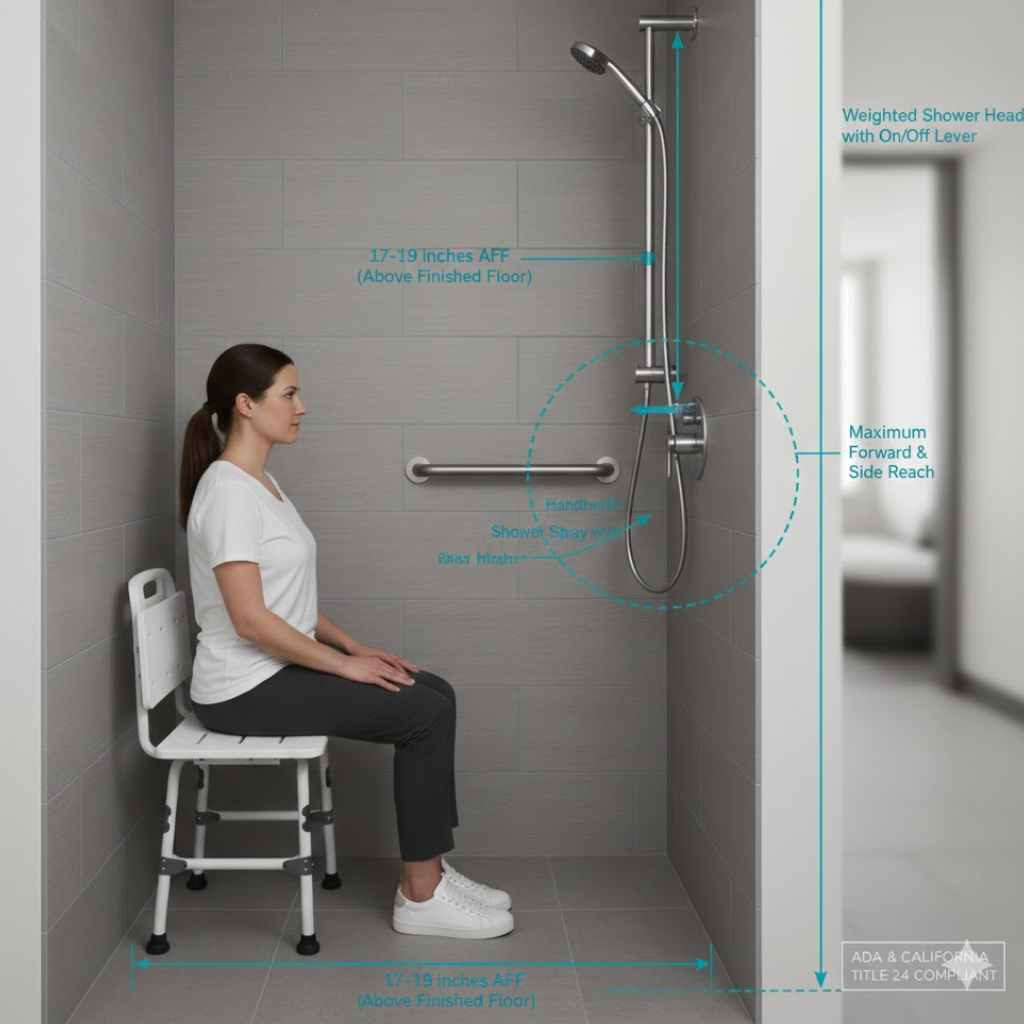
Shower seat
Top of seat 17 to 19 inches above the finished floor
Seat depth 15 to 16 inches
Controls and handheld spray
Operable with one hand
Mounted no higher than 48 inches above the finished floor
Common hotel failure: roll in shower installed but controls placed outside reachable range once the seat is occupied.
Sinks, Mirrors, and Storage Shelves
Sink areas fail when designers focus on style over clearance. Vessel sinks, thick counters, or decorative shelving often eliminate knee space or push controls out of reach.
Inspectors check whether a wheelchair user can roll under the sink and use it without twisting or strain.
Exact measurements inspectors verify
Knee clearance under sink
Minimum 27 inches high
Minimum 30 inches wide
Minimum 19 inches deep
Clear floor space
30 by 48 inches positioned for forward approach
Faucet controls
Operable with one hand
No tight grasping or twisting
Mirrors
Bottom edge of reflecting surface no higher than 40 inches above the finished floor
Shelves and accessories
Within forward reach range
Maximum 48 inches above the finished floor
Common hotel failure: decorative sink cabinets added after inspection that eliminate knee clearance.
Faucets, Controls, and Hardware
This is where hotels lose inspections due to product selection. Hardware that looks compliant on paper often fails in real use.
Inspectors physically test operability. If it requires tight grip, twisting, or excessive force, it fails.
Exact measurements inspectors verify
Operable parts
Usable with one hand
No tight grasping, pinching, or twisting
Operating force no greater than 5 pounds
Reach range
Forward reach maximum 48 inches
Side reach maximum 48 inches with proper clearance
Common hotel failure: stylish faucet handles that require wrist rotation.
Floor Space, Door Swings, and Turning Radius
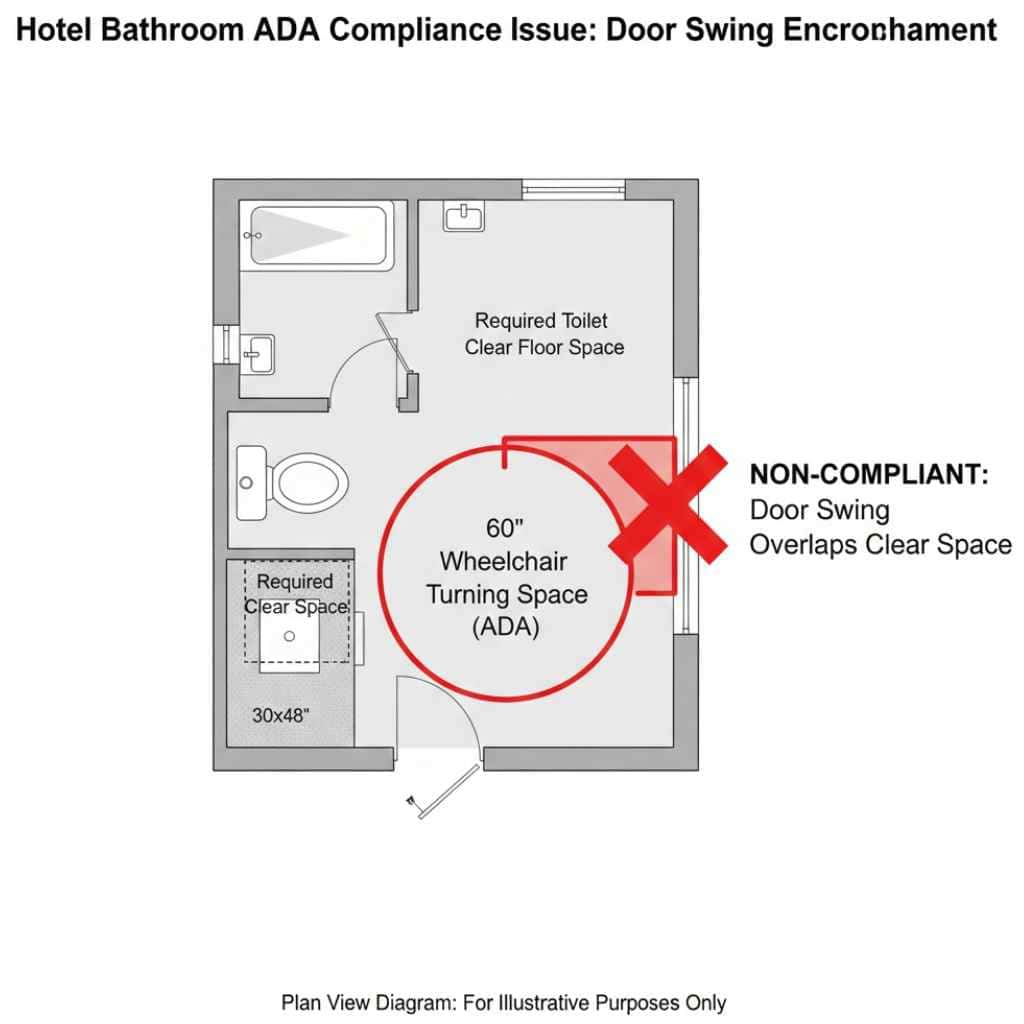
This is the silent failure that shows up after everything else looks correct. Door swings and circulation space are evaluated together.
Inspectors simulate movement through the room, not just static clearances.
Exact measurements inspectors verify
Turning space
60 inch diameter circular space or compliant T turn
Door swings
Must not encroach into required clear floor space at fixtures
Approach paths
Clear route between entry, toilet, sink, and shower without obstruction
Common hotel failure: bathroom door swings into the sink clearance or toilet transfer area.
Accessible Route Into the Guest Room Bathroom
Accessibility does not begin at the toilet or the shower. It begins at the path into the bathroom. This is one of the earliest failure points inspectors find in hotel guest rooms.
An accessible route must connect the sleeping area to the bathroom so a guest using a wheelchair or mobility device can enter independently. Inspectors verify door clear width, maneuvering clearance on the pull and push sides of the door, and whether thresholds interrupt access. These measurements are taken from finished surfaces, not drawings.
Bathroom doors that swing into required maneuvering space or thresholds that exceed allowable height are common violations. Even when every fixture inside the bathroom is compliant, a blocked or noncompliant entry route causes the entire room to fail.
This issue shows up most often during renovations. Fixtures are upgraded, but door locations, swings, or thresholds are left unchanged. Inspectors treat that as a functional barrier, not a minor oversight.
Why this matters. ADA and California Title 24 evaluate usability as a complete system. A compliant shower inside a bathroom that cannot be entered independently does not meet accessibility requirements.
Bathtub and Shower Unit Requirements in California Hotels
This is where hotel projects fail most often. Not because the room lacked an accessible bathing option, but because the wrong type was installed or the details were off by inches. Inspectors do not debate intent here. They verify whether the bathing unit works for a guest with limited mobility using real measurements.
When Is a Bathtub Allowed in Accessible Rooms?
A bathtub is allowed in certain accessible guest rooms, but only when it meets the ADA bathing criteria for tubs and the room type permits it. Under the ADA, some mobility accessible rooms may use bathtubs instead of showers. California Title 24 allows this as well, but only if the tub configuration meets all required clearance and grab bar rules.
Here is what trips hotels up. A standard hotel tub with decorative grab bars or a slip resistant surface is not an accessible tub. Inspectors look for compliant grab bars mounted 33 to 36 inches above the finished floor, a clear floor space of at least 30 inches by 48 inches positioned along the tub, and controls that can be reached from a seated position without twisting or standing.
If a tub is installed but lacks proper clearance or usable controls, the entire room fails. There is no partial credit.
Shower Seat Sizes, Placement, and Load Rating
Shower seats are mandatory in accessible showers, and this is one of the most measured elements during inspection. ADA 2010 requires a rectangular shower seat with a minimum size of 24 inches wide by 16 inches deep. The seat must be mounted 17 to 19 inches above the finished floor and support at least 250 pounds.
Placement matters as much as size. The seat must be located on the correct wall based on the shower type so a guest can transfer safely. Inspectors physically test stability. Loose mounting or decorative fold down seats without proper backing are common failure points in California hotels.
Grab Bar Configurations for Different Shower Types
Grab bar placement depends on the shower type, and mixing configurations is a fast way to fail inspection. Transfer showers, roll in showers, and tub shower combinations all have different grab bar layouts under ADA and Title 24.
Inspectors verify that grab bars are mounted between 33 and 36 inches above the finished floor and are positioned on the correct walls to support entry, transfer, and seated use. Missing a rear grab bar or installing bars only on one wall is enough to fail the room, even if everything else is compliant.
Hotels often assume the manufacturer diagram is sufficient. It is not. Field conditions control.
Shower Controls and Distance From the Seat
Shower controls must be reachable from the seated position without stretching or standing. Under ADA 2010, controls must be mounted no higher than 48 inches and no lower than 38 inches above the finished floor. They must also be located on the control wall so a seated user can operate them with one hand.
This is where California inspections get strict. If the control is technically within height limits but placed too far from the seat to operate safely, inspectors will flag it. Lever handles, push controls, or touchless valves must operate with minimal force and without tight grasping.
Hotels fail this when controls are centered for aesthetics rather than accessibility.
A hotel can meet room count requirements and still fail inspection because one shower seat was undersized, one grab bar was missing, or one control was out of reach. These are not design preferences. They are pass or fail conditions in California.
Reach Ranges and Operable Controls That Commonly Fail ADA Inspections
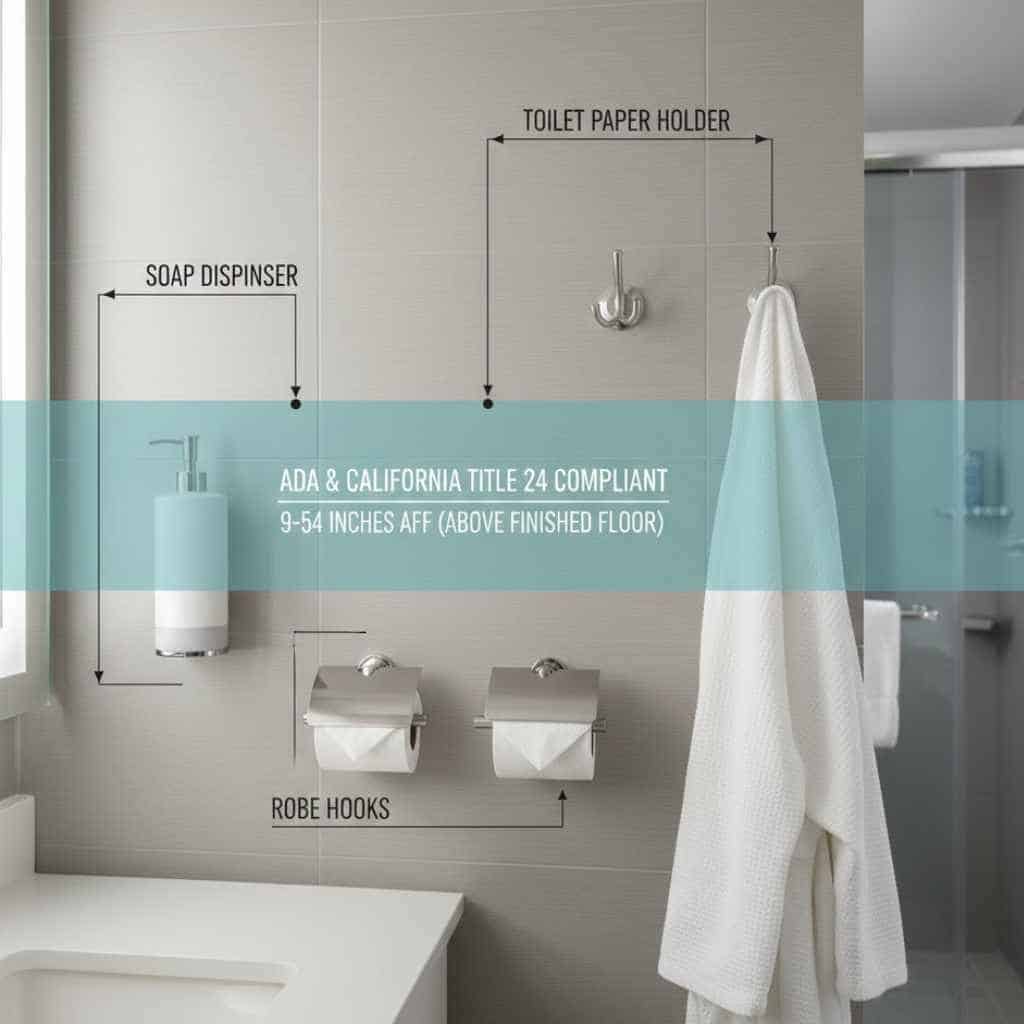
Reach ranges and operable parts are where accessible hotel bathrooms quietly fail inspection. Not because the fixtures are missing, but because they are placed just outside the allowable reach or require more effort than the ADA allows. Inspectors do not test intent. They test usability. If a guest cannot reach or operate a control independently, the room does not pass.
Here is how reach ranges and controls are evaluated in California hotel guest rooms, and where mistakes usually happen.
How Inspectors Measure Reach Ranges for Shower and Sink Controls
Inspectors measure reach from the perspective of a seated user. That measurement starts at the finished floor and ends at the highest operable part a guest must touch.
Under the ADA 2010 Standards, operable parts must generally be within a forward or side reach range of 15 inches minimum to 48 inches maximum above the finished floor. California Title 24 enforces this strictly and does not allow design tolerance or rounding.
This applies to:
Shower valves and diverters
Handheld shower spray controls
Sink faucet handles
Drain stoppers and push controls
A common failure occurs when controls are mounted at standing height or aligned with tile lines instead of measured from the finished floor. Inspectors measure with a tape. Visual alignment does not matter.
Why this matters. If a guest must lean, stretch, or lift their arm above shoulder height while seated, the control is considered out of reach.
What Faucet and Control Types Are Allowed in Accessible Bathrooms
Control type matters as much as placement. The ADA requires that operable parts be usable with one hand and not require tight grasping, pinching, or twisting of the wrist.
In accessible hotel bathrooms, this means:
Lever handled faucets are acceptable
Push button or sensor operated faucets are acceptable
Twist knobs that require grip strength are not acceptable
Inspectors physically test controls. If a control requires sustained pressure, fine motor coordination, or wrist rotation, it fails regardless of manufacturer claims.
Why this matters. An ADA compliant room must be usable without assistance. If a guest cannot turn the water on independently, the room is not accessible.
Where Soap Dispensers and Toilet Paper Holders Must Be Mounted
Soap dispensers and toilet paper holders are frequently installed last and rarely measured. That is exactly why they trigger violations.
These fixtures must:
Be within the allowable reach range
Not be blocked by grab bars, partitions, or toilet tanks
Be reachable from the required clear floor space
Toilet paper dispensers must be placed so a seated user can reach them without leaning forward or twisting beyond normal range. Mounting behind grab bars or too far forward of the toilet is a common inspection failure.
Inspectors treat these as operable parts. If a guest cannot reach them independently, the room fails even if every major fixture is correct.
ADA Rules for Coat Hooks, Robe Hooks, and Shelves
Coat hooks, robe hooks, and shelves are regulated when they are provided in accessible guest rooms. This surprises many owners.
When provided, hooks and shelves must be mounted within the 15 to 48 inch reach range. There is no exception because the item is optional or decorative.
This applies to:
Robe hooks near showers
Coat hooks near entry doors
Towel hooks intended for guest use
Inspectors do not remove fixtures from consideration because they are not essential. If it is installed and intended for guest use, it must comply.
Optional features create mandatory obligations once installed. This is a frequent source of avoidable violations.
What Owners and Contractors Get Wrong Most Often
The most common failures in this section are not design errors. They are coordination errors.
Controls are installed after plan check. Finish heights change. Tile thickness is ignored. No one remeasures.
ADA compliance is not about averages. Every control must independently meet reach and operability requirements.
If one control fails, the accessible bathroom fails.
California Title 24 Requirements That Go Beyond Federal ADA Standards
Inspection Checklist for ADA Compliant Hotel Bathrooms
Many hotel owners believe that meeting the ADA 2010 Standards is enough. In California, that assumption leads to failed inspections. Title 24 is an enforceable building code, not guidance. Inspectors apply it independently, even when ADA minimums appear satisfied.
This is where California goes further and why projects that pass elsewhere often fail here.
How California Bathroom Layout Rules Differ From ADA
The ADA sets national minimums. California Title 24 tightens how those minimums function together inside the room.
Inspectors focus on overall usability, not isolated compliance. They evaluate how:
Clear floor space overlaps between fixtures
Door swings encroach into required maneuvering areas
Fixture spacing affects approach and transfer
A bathroom can meet ADA minimum dimensions and still fail Title 24 if the combined layout restricts movement. Inspectors do not average compliance across elements. They evaluate whether the room works as a unit.
Why this matters. A layout that technically complies on paper can still be rejected in the field.
Extra Grab Bar and Door Rules Enforced in California
Grab bars and doors are two of the most common Title 24 failure points. California inspectors measure them aggressively.
During inspection, they verify:
Exact grab bar placement relative to walls and fixtures
Required extensions and continuity of grab bars
Door swing direction and overlap with required clear floor space
Maneuvering clearance on both sides of the door
Door hardware is also evaluated in real conditions. Opening force, closer resistance, and latch usability are checked after installation, not assumed from specs.
Why this matters. These violations usually appear after construction, when corrections affect schedules, occupancy, and budgets.
Mistakes California Hotels Repeatedly Make
Most failures are not caused by ignoring accessibility. They are caused by assumptions that do not hold up under inspection.
The patterns inspectors see most often include:
Using out of state prototype drawings without California review
Relying on manufacturer installation diagrams instead of code
Allowing door swings to overlap required clearance
Treating grab bars as decorative rather than functional supports
These are not rare mistakes. They show up consistently in failed inspections.
Why this matters. Repeated mistakes lead to predictable delays and corrective work.
How CASp Inspectors Apply Title 24 During Site Visits
CASp inspections are measurement driven, not interpretive. Inspectors document conditions exactly as they exist.
During site visits, CASp inspectors:
Measure from finished surfaces, not drawings
Test door operation and hardware in real use
Verify reach ranges and clearances with fixtures installed
Document any deviation, even if it appears minor
A room does not partially pass. If one required element fails, the accessible bathroom fails.
Inspection Checklist for ADA Compliant Hotel Bathrooms
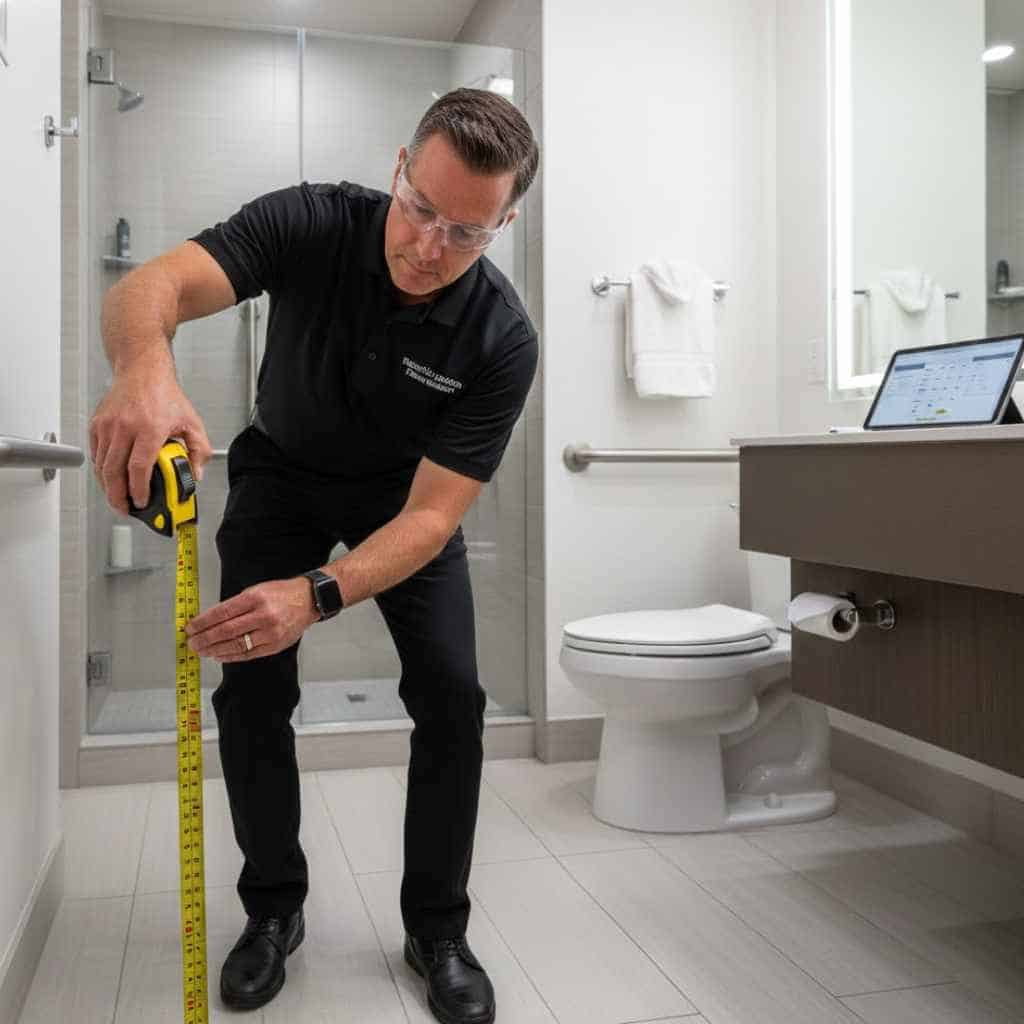
This is the part hotel owners usually wish they had before inspection day. ADA compliance is not judged by intent or drawings. It is judged by what exists in the room at the moment the inspector walks in. When something fails, the consequence is not theoretical. It shows up as delayed approvals, withheld occupancy, corrective work orders, or legal exposure.
Understanding how inspections actually happen helps you avoid those outcomes.
What CASp Inspectors Look For During Site Visits
CASp inspectors verify conditions in the field, not on paper. Plans are background material. Measurements and usability control the outcome.
Inspectors use measuring tapes, digital levels, and slope gauges to confirm compliance. They measure from finished surfaces, not rough framing or intended dimensions. Tile thickness, base trim, and hardware installation all count.
They also compare field conditions against the approved plan set, but field conditions always control. If the plan shows compliance and the room does not, the room fails. That failure can stop final sign off or trigger required corrections before the space can be legally used.
Passing plan review does not protect you. Inspection failure delays opening and creates documentation that can later be used in enforcement or litigation.
Pre Inspection Red Flags for Hotel Operators
Most inspection failures fall into a predictable pattern. These are the issues CASp inspectors flag most often in hotel bathrooms.
Before inspection, review for these common failures:
Grab bars mounted a few inches off spec
Door swings overlapping required clear floor space
Toilet centerlines shifted during finish work
Shower controls mounted at standing height
Seats or bars installed after tile without remeasurement
Clear floor space blocked by trash bins or carts
Mirrors mounted above allowable viewing height
Controls requiring tight grip or twisting
Slopes exceeding allowable limits at shower entry
Accessible rooms altered during value engineering
These are the same items that lead to fix it notices, inspection rechecks, and delayed occupancy. Once documented, they are difficult to ignore and expensive to correct late.
How to Avoid Fix It Citations or Accessibility Lawsuits
Most enforcement problems begin with something small. A single failed element leads to closer scrutiny. That scrutiny often expands beyond the bathroom that triggered it.
You reduce risk by:
Measuring critical elements after final installation
Walking the room from a seated user perspective
Testing all operable parts with one hand
Confirming clear floor space remains unobstructed
A fix it citation creates a paper trail. That trail can later support an ADA or Unruh Act claim if the issue is not corrected promptly.
Post Renovation ADA Compliance Validation
After renovation, compliance should be confirmed, not assumed. Skipping validation is one of the most common mistakes hotel owners make.
A CASp inspection should be scheduled once the room is fully complete and before public use. This allows deficiencies to be corrected without enforcement pressure.
A CASp report documents the condition of the room at a specific point in time. When deficiencies are addressed in a timely manner, that report can reduce statutory damages and improve your legal position if a complaint is filed later.
Without documentation, your defense relies on intent. With documentation, you rely on evidence.
Common Compliance Mistakes That Trigger Lawsuits or Failed Inspections
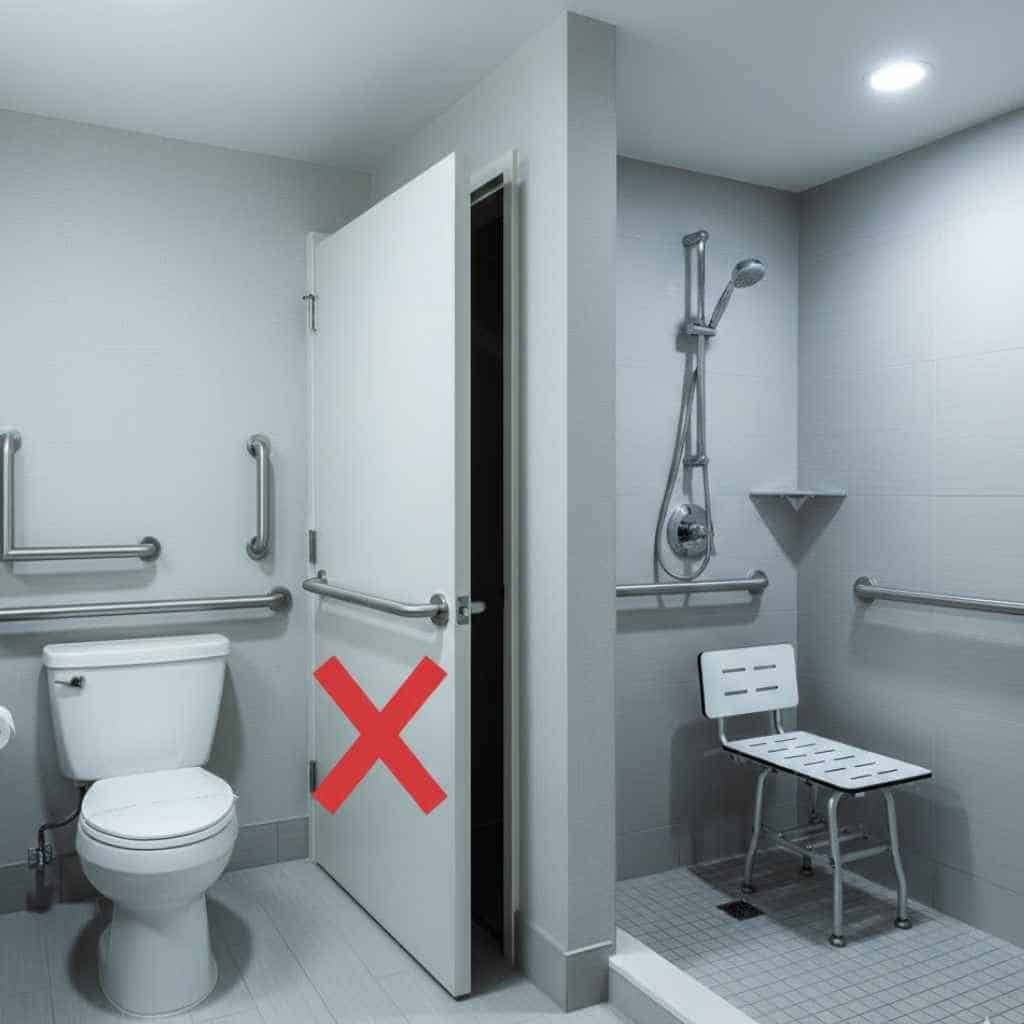
Most ADA hotel bathroom failures do not come from missing fixtures. They come from fixtures that are installed slightly wrong. An inch here or a swing there is enough to turn a compliant room into a liability. These are the issues that show up repeatedly in CASp reports and lawsuit photos.
Grab Bars Installed Too Low or Too Short
Grab bars must be mounted within a specific vertical range and must extend far enough to support transfers.
In accessible toilet compartments and guest room bathrooms, horizontal grab bars are required to be mounted 33 to 36 inches above the finished floor, measured to the top of the gripping surface. Bars that fall outside this range fail immediately.
Length matters just as much. Rear and side grab bars must meet minimum length requirements so a user can reposition safely. Shortened bars or decorative trims at the ends often look intentional but still fail inspection.
Grab bar errors are easy to photograph and hard to defend. They are one of the fastest ways a room loses its accessible designation.
Shower Controls Out of Reach From the Seat
Shower controls must be operable from a seated position without stretching or standing.
In roll in and transfer type showers, controls are required to be located within a maximum of 27 inches from the seat wall and within allowable reach ranges so the user can adjust temperature and flow while seated.
A common failure is placing controls on the far wall to align plumbing stacks or aesthetics. Inspectors measure from the seat, not from the doorway or centerline.
If a user has to stand to reach controls, the shower is unusable. That is not a minor issue. It disqualifies the room.
Doors Swinging Into Clearance Zones
Door swings cannot encroach into required clear floor space.
Bathroom doors, shower doors, and even sliding barn style doors are frequently installed without checking how they interact with turning space and fixture clearances.
A door that swings into the toilet clearance or blocks approach space to the sink turns a compliant layout into a failure after construction is complete.
Why this matters. Door conflicts are expensive to fix late. They often require re hanging doors or reframing openings after finishes are installed.
Toilet Off Center From Required Space
Toilets must be positioned precisely within the required clearance envelope.
Accessible toilets are required to be centered 16 to 18 inches from the adjacent side wall, measured to the centerline of the toilet. Installers often drift outside this range when rough plumbing is adjusted in the field.
Even a half inch beyond the allowed range is enough to fail inspection.
A toilet that is off center cannot be corrected without moving plumbing. That can remove a room from service.
Fixtures Mounted Outside Reach Range
Accessories must fall within allowed reach ranges for seated users.
Soap dispensers, towel hooks, toilet paper holders, and shelves are frequently installed based on convenience rather than measurement. If a fixture falls outside the permitted reach range from a clear floor space, it becomes an access barrier.
Inspectors do not ignore small accessories. They document them.
These items are often added last. They are also one of the easiest ways to turn a passed plan set into a failed inspection.
Legal Risks of Non-Compliance in California Hotels
Non-compliant hotel bathrooms do not fail quietly. In California, they fail publicly, expensively, and often repeatedly. Once a bathroom is documented as unusable by a guest with a disability, the issue shifts from construction oversight to civil rights exposure. That shift is what most hotel owners underestimate.
Here is how these cases actually unfold.
Common ADA Lawsuits Hotels Face Over Bathrooms
Most hotel ADA cases tied to bathrooms follow a predictable pattern. A guest encounters a physical barrier that prevents independent use. That barrier is documented. A claim follows.
Common allegations include:
Inability to transfer to or use a shower due to control placement or missing grab bars
Toilets positioned outside required clearance, making side transfer impossible
Doors or fixtures blocking required maneuvering space
Fixtures mounted outside allowable reach ranges
A frequent real-world trigger is a roll-in shower where the controls are mounted beyond reach from the seat. On paper the room is accessible. In use, it is not. That single failure is enough to support a claim for unequal access.
These lawsuits are not about intent. They are about usability.
Statutory Penalties and Cost of Retrofits
California adds real financial weight to accessibility violations.
Under the Unruh Civil Rights Act, statutory damages are $4,000 per violation, per visit, plus attorney fees. One guest. One stay. One non-compliant bathroom can multiply quickly if the condition remains uncorrected.
Beyond damages, courts regularly require:
Mandatory remediation within fixed timelines
Verified compliance documentation
Follow-up inspections
Retrofits are rarely minor. Moving plumbing walls, relocating controls, reconfiguring shower layouts, or replacing door assemblies costs far more after occupancy than during planned construction.
One critical reality many owners miss: general liability insurance often excludes ADA access claims, treating them as civil rights matters rather than accidents. That means defense costs and settlements are frequently paid out of pocket.
Avoiding Serial Litigants and Legal Exposure
California is home to well-known plaintiff firms that specialize in ADA access claims. Hotels are common targets because guest rooms are easy to document and violations are repeatable across units.
The strongest risk reduction step is proactive verification, not reactive defense.
A CASp inspection does two important things:
Identifies barriers before they become claims
Positions the property for Qualified Defendant status if litigation occurs
Qualified Defendant status does not prevent lawsuits, but it can significantly reduce statutory damages and compress litigation timelines when owners act promptly.
From a risk standpoint, the equation is simple. Measuring and correcting early is cheaper than defending late. Hotels that treat accessible bathrooms as regulated systems rather than design features are the ones that avoid repeat exposure.
How to Prepare Your Hotel Bathrooms for CASp Inspection
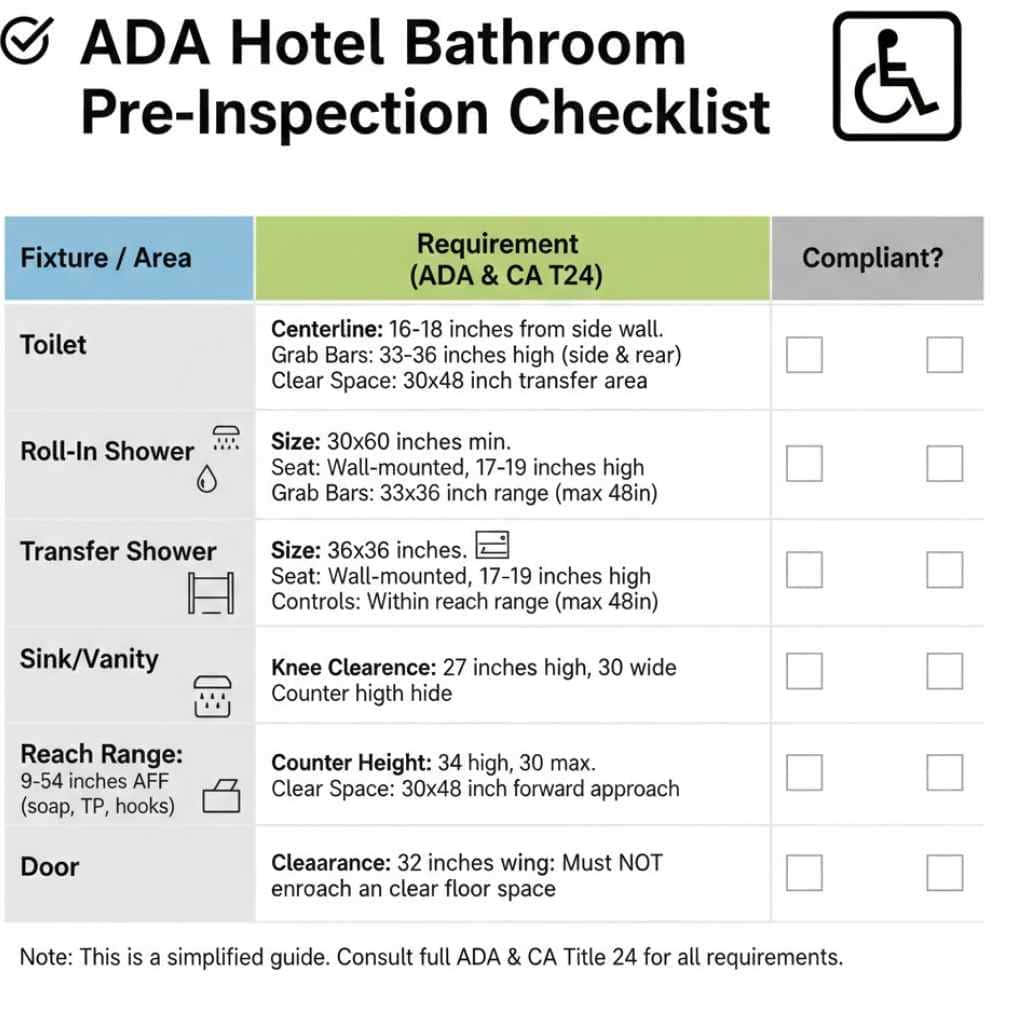
Preparing for a CASp inspection is not about aiming for a clean report. It is about avoiding operational disruption, legal exposure, and forced retrofits that cost more after the fact. Most hotel owners who fail inspections did not ignore accessibility. They assumed close enough would pass. In California, that assumption is expensive.
Pre-Inspection Checklist for Mobility Unit Bathrooms
Before an inspector ever walks the site, every mobility unit bathroom needs to function exactly as required in real use, not just on drawings. Toilets must be centered within required clearances. Grab bars must be at the correct height and length. Shower controls must be reachable from the seat. Doors must clear maneuvering space without encroachment.
Here is why this matters. If even one required bathroom element fails, the entire guest room can lose its accessible designation. That affects your required room count under ADA Section 224. Losing a compliant room is not a paperwork issue. It can trigger reclassification, rework, and exposure if a guest files a complaint before corrections are complete.
Diagram Tools and Measuring Tips
Use real tools, not estimates. Tape measures, digital levels, and door swing arcs reveal problems that plan sets miss. A grab bar that looks fine on a wall often fails once you measure from the finished floor. A door that clears on paper often swings into required floor space in reality.
This is where many hotels get caught. Inspectors measure finished conditions, not intent. If the field condition does not match code, it fails. At that point, corrections are no longer optional or flexible. They are documented and time bound.
When to Hire a CASp or Accessibility Consultant
If your hotel is new, recently renovated, or preparing for brand review, a CASp inspection before opening or reoccupancy is a risk control step, not a formality. A qualified CASp report establishes a baseline and shows good faith if a claim is filed later.
Without that report, you are exposed. If a complaint comes in first, you lose control of the timeline. Corrections happen under legal pressure instead of planning. Costs increase. Flexibility disappears.
What Happens If You Fail an Inspection
Failing a CASp inspection does not automatically shut down operations, but it does start a clock. Identified barriers must be corrected within specific timeframes. If a guest or plaintiff documents the same issues before fixes are complete, you may face statutory damages under California law plus forced modifications.
The most damaging part is not the citation. It is that failure creates a paper trail. Once documented, accessibility barriers are no longer hypothetical. They are known conditions. That changes how courts, regulators, and insurers view your property.
Passing inspection keeps you operational. Failing inspection creates ongoing exposure until every item is corrected and verified.
Quick Answers to Common ADA Hotel Bathroom Questions
Are all hotel bathrooms required to be ADA compliant in California?
No. Only designated accessible guest rooms must have fully compliant bathrooms.
Hotels are required to provide a specific number of accessible guest rooms based on total room count under ADA Section 224. Only those rooms must meet full accessibility standards. Standard guest rooms are not required to be ADA compliant unless they are altered in a way that triggers accessibility upgrades. That said, once a room is designated as accessible, every required bathroom element must comply. Partial compliance is not allowed.
What is the minimum space needed in a hotel bathroom for a wheelchair?
There is no single room size requirement. The space must support required clearances and turning.
ADA requires a clear floor space that allows a wheelchair to approach and use each fixture, plus a turning space that allows either a sixty inch diameter turn or a compliant T shaped turn. California Title 24 enforces these clearances strictly during inspection. If doors, fixtures, or layouts block these spaces, the bathroom fails regardless of overall square footage.
Can a hotel pass a CASp inspection with minor noncompliant features?
No. CASp inspections are pass or fail on each measured condition.
There is no concept of minor when it comes to accessibility. A grab bar mounted an inch too high, a control just out of reach, or a door that swings into required clearance is still a violation. CASp reports document each noncompliant element individually. One failure does not cancel the entire inspection, but it does eliminate clean compliance status until corrected.
Are grab bars required in all hotel guest bathrooms?
No. Grab bars are required only in accessible guest room bathrooms.
In designated accessible rooms, grab bars are mandatory at toilets and in bathing fixtures according to the specific configuration used. In standard guest rooms, grab bars are not required unless the room is designated or altered as accessible. However, once installed in an accessible room, grab bars must meet exact placement, height, and length requirements. Decorative or incorrectly placed bars are treated as violations.
Can a roll in shower be replaced with a tub in an accessible room?
Sometimes, but only if required room type counts are still met.
ADA requires a mix of accessible bathing types across the total accessible room inventory. Some rooms must provide roll in showers, others may use tubs with seats. A hotel cannot replace a required roll in shower with a tub if doing so drops below the minimum number of roll in shower rooms required by ADA Section 224. California inspectors check this at the inventory level, not just room by room.
Do ADA bathrooms need automatic door openers?
No. Automatic operators are not required for guest room bathroom doors.
ADA requires doors to be operable with limited force and without tight grasping, pinching, or twisting. As long as door hardware meets operability standards and required maneuvering clearances are provided, automatic openers are not required inside guest rooms. They may be required in certain public spaces, but not within the guest room bathroom itself.
What is the best way to check if my hotel bathrooms are ADA ready?
Measure the existing conditions against ADA and California Title 24, then verify with a CASp inspection.
Do not rely on plans, brand standards, or product labels. Measure clearances, heights, reach ranges, and door swings in the finished space. A CASp inspection provides documented verification and establishes a defensible compliance record. Hotels that wait until after a complaint are almost always reacting too late.
When to Hire a CASp or Accessibility Consultant
You bring in a CASp or accessibility consultant before a problem becomes enforceable, not after it shows up in writing.
The right time is when a hotel is newly built, recently renovated, preparing for brand review, or planning any alteration that touches guest room bathrooms. At that stage, measurements can still be corrected without rework, schedule delays, or documented violations.
Once a complaint, inspection failure, or demand letter exists, the dynamic changes. Timelines tighten. Flexibility disappears. Corrections become reactive instead of planned. Costs rise.
A qualified CASp inspection establishes a documented snapshot of existing conditions under current ADA and California Title 24 standards. That record matters. It shows what existed, when it existed, and whether deficiencies were addressed in a reasonable timeframe.
This is not about passing or failing in theory. It is about controlling exposure in the real world.
Hotels that wait until after a problem surfaces usually discover the same thing: correcting issues under pressure is always more expensive than verifying compliance early.
Trusted Resources for ADA Hotel Bathroom Rules in California
https://www.ada.gov/law-and-regs/design-standards/
https://www.dgs.ca.gov/BSC/Codes
https://archive.ada.gov/hsurvey.htm